Your Guide to a Flawless Auto Shop Receipt Template
Stop losing time and trust. This guide shows you how to create a professional auto shop receipt template that protects your business and keeps customers happy.

An auto shop receipt template is simply a pre-made document that lays out all the essential info you need to give a customer after a job. It’s the easiest way to make sure you don't forget crucial details—like parts, labor, and taxes—which helps build trust and, more importantly, prevents arguments over the bill.
Why a Professional Receipt Is Your Most Important Tool

Let's be real—a receipt is so much more than a piece of paper confirming a payment. It's your last handshake with the customer and a physical reminder of your shop's professionalism. A well-designed receipt does more than just add up the numbers; it builds instant trust and becomes a key asset for your business.
Think about the last time you had a customer question a charge. A scribbled, generic note just invites doubt. On the other hand, a detailed, itemized receipt that clearly breaks down parts from labor can turn a potential argument into a moment of transparent customer service.
Building Credibility and Preventing Disputes
Using a solid template for every transaction creates consistency. When every customer walks away with a document that clearly lists out every single thing you did, it reinforces your shop's credibility. That level of detail is priceless out in the real world.
For instance, picture a customer trying to file an insurance claim after a collision repair. A meticulously detailed receipt—listing every part number, every hour of labor, and all the paint materials—can make all the difference for a quick, successful claim. You just turned a nightmare situation into a smooth experience, and that's how you build a reputation that lasts.
A receipt isn't just paperwork; it’s a communication tool that shows you're transparent and protects your business. It also acts as a legal record, outlining the agreement you made with the customer and clarifying any warranty terms on parts or labor.
Operating in a Booming Market
The auto repair industry is absolutely exploding. Market estimates vary, but everyone agrees on the massive growth—the sector was valued somewhere between USD 779.3 billion and USD 1.1 trillion in 2024 and is expected to hit a staggering USD 2.4 trillion by 2034. That boom means more cars, more jobs, and a much bigger need for good documentation.
For mechanics, body shops, and mobile techs, this isn't the time to wing it. Standardized systems are non-negotiable. A professional auto shop receipt isn't just about looking the part; it's about running an efficient business and protecting yourself in a competitive market.
Plus, keeping these records straight is a lifesaver come tax season. If you want to get a jump on that, check out our guide on how to organize receipts for taxes.
What Goes into a Rock-Solid Auto Repair Receipt?
A good receipt tells a clear story. It walks your customer through every step of the repair, from the moment they dropped off the keys to the final handshake. It leaves zero room for confusion or arguments later. Forget those generic templates; a truly professional receipt breaks everything down into logical chunks.
Let's break down the essential pieces that make a receipt both legally sound and easy for your customers to understand.
It all starts at the top. Your shop's logo, name, address, phone number, and website should be front and center. This isn't just branding; it's your professional handshake. Right below that, you need the customer's full name and contact info to make it personal and connect the work to their service history.
Next up, you have to get the vehicle's vitals down cold. This isn't just for your records—it's absolutely critical for things like warranty claims and keeping track of service history.
- Year, Make, and Model: The basics, but don't skip them.
- Vehicle Identification Number (VIN): This is the car's fingerprint. It's a non-negotiable field that prevents any mix-ups.
- License Plate Number: Another easy identifier for the customer to recognize.
- Mileage at Time of Service: This is a crucial snapshot for tracking maintenance schedules and proving warranty validity.
Laying Out the Parts and Labor
This is the heart of your receipt and, frankly, where most disputes happen if you're too vague. The goal here is total transparency. Never, ever lump charges together under a single line item like "Brake Job."
You need two separate, crystal-clear categories: Parts and Labor.
Think about a common alternator replacement. Instead of one line for $430, break it down like this:
| Category | Description | Quantity | Unit Price | Total |
|---|---|---|---|---|
| Parts | OEM Alternator (Part #123-ABC-456) | 1 | $250.00 | $250.00 |
| Labor | Alternator Replacement (Mechanic J. Doe) | 1.5 hrs | $120.00/hr | $180.00 |
This level of detail answers questions before they're even asked. It shows the customer exactly what they're paying for and gives them the documentation they'd need for a warranty claim on that alternator down the road. You can get even more granular with this by checking out our guide on how to build an itemized receipt template.
Nailing the Numbers
After you’ve itemized every part and all the labor, the bottom of your receipt needs to present the financial summary cleanly. You want to avoid any sticker shock and make the math dead simple to follow.
Start with a subtotal that adds up all the parts and labor. Then, list any applicable state and local taxes as their own line items. If you ran a special or gave them a discount, show that deduction clearly.
Finally, the grand total should be big, bold, and impossible to miss. This simple, logical path from the subtotal to the final amount is a huge trust-builder.
Key Takeaway: The best receipt is an itemized one. By cleanly separating parts from labor and detailing every single charge, you create a transparent record that protects your shop, makes the customer feel confident, and kills potential disputes before they start.
This kind of precise documentation is the backbone of the global automotive repair market, a massive industry valued at USD 744.4 billion in 2025 and projected to soar to USD 1,056.6 billion by 2034. For your shop to grab a piece of that pie, a professional, trustworthy receipt isn't just nice to have—it's essential. You can find more data on the automotive repair service market over at IMARC Group.
Tailoring Your Template for Specialized Services
Let's be real: a receipt for a quick oil change shouldn't look anything like an invoice for a full collision rebuild. Using a generic, one-size-fits-all template is a recipe for confusion. It looks unprofessional and, frankly, lazy. To build trust with your customers, your receipts need to match the job you just did.
Adapting your template for different services shows you pay attention to the details. A simple maintenance job can be straightforward, but complex repairs demand a much more granular breakdown. It's all about providing clarity, no matter the scope of the work.
General Mechanic Template
If you're a general mechanic, your day is filled with brake jobs, diagnostics, and tune-ups. Your receipt template should reflect that pace—it needs to be fast, clear, and easy to understand at a glance. The goal is to get the customer paid and on their way without a dozen questions.
Here’s what to focus on:
- Specific Labor Descriptions: Don't just write "Brake Service." Get specific: "Replaced Front Brake Pads & Rotors." This tells the customer exactly what they paid for.
- Itemized Parts List: Break it down clearly. List each part, its part number, and the price (e.g., "Brake Pads - Part #D1044").
- Clean Totals Section: Keep it simple. A clear subtotal for parts, another for labor, add the tax, and finish with a bold grand total. No guesswork involved.
A well-structured template for common repairs cuts down on customer questions and makes checkout a breeze. It's about making the payment process as smooth as the new oil you just put in their engine.
No matter your specialty, every professional receipt is built on the same foundation. This visual breaks down the absolute must-haves.
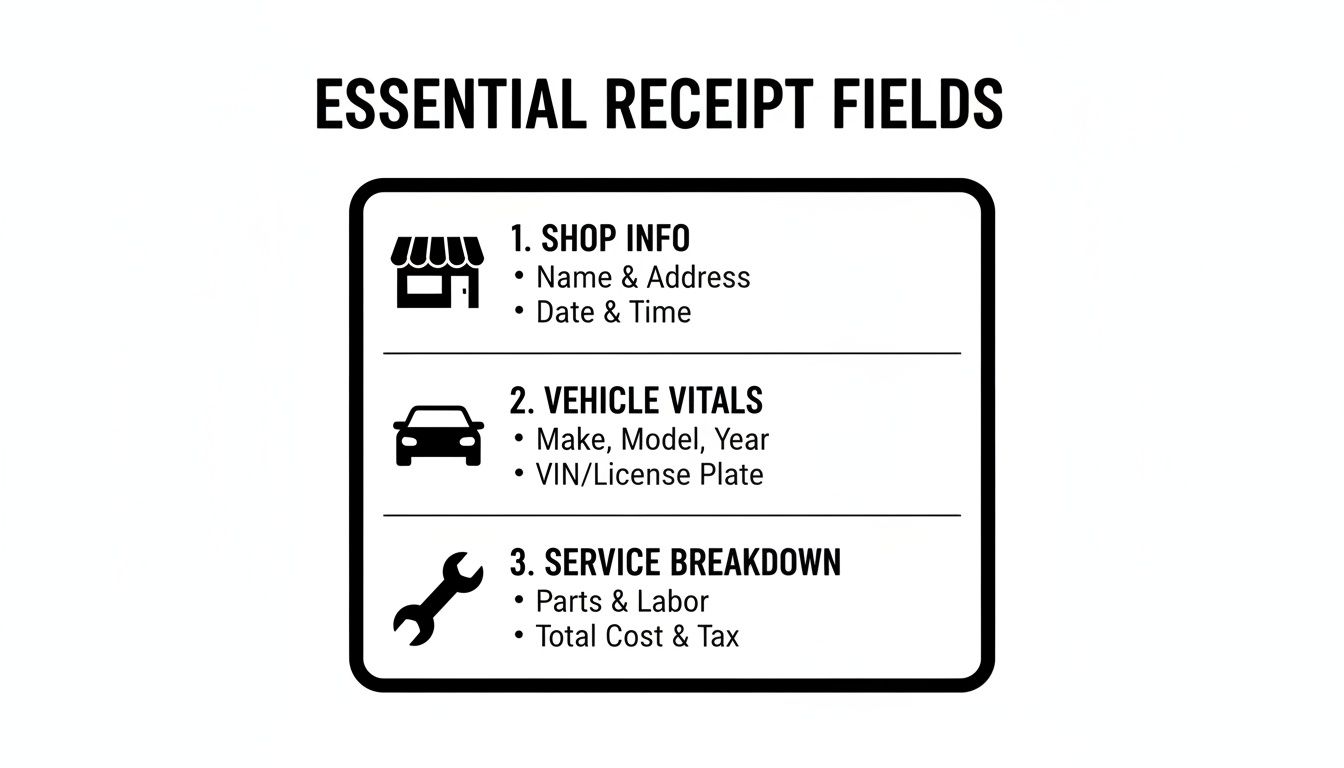
As you can see, core info like your shop's details, the vehicle's vitals, and a clear service breakdown form the backbone of any receipt you create.
Collision and Body Shop Template
Body shop receipts are a whole different ball game. You’re often dealing with insurance claims, which means every single line item needs to be justified. Your template has to be built for an extreme level of detail.
In addition to the standard parts and labor, you absolutely need separate line items for:
- Materials: This isn't just paint. It’s primer, clear coat, seam sealer, and other consumables. Many shops bill this per paint hour.
- Sublet Repairs: Did you have to send the car out for a frame alignment or glass replacement? That needs its own line showing the vendor and what you were charged.
- Paint vs. Body Labor: You have to separate the hours spent on physical bodywork (pulling dents, replacing panels) from the time spent in the paint booth.
This isn't optional. Insurance adjusters require this level of detail, and it gives the customer a transparent view of the massive amount of work that goes into restoring their vehicle.
Mobile Mechanic Template
For mobile techs, life is all about efficiency. Your receipt template needs to be streamlined for work on a tablet or a phone. The main goal is generating and firing off a professional receipt right there in the customer's driveway.
A mobile-friendly version should have a simple layout with large, easy-to-tap fields. It needs to clearly list the service, the parts, and the total cost without any extra fluff. The ability to email or text a PDF copy to the customer on the spot is non-negotiable for a modern mobile mechanic.
If you find yourself doing a lot of the same simple jobs, you might find our dedicated oil change receipt templates are already optimized for that kind of speed.
Adding Brand Trust and Legal Protection
A good receipt does more than just tally up the bill. Think of it as the final handshake with your customer—it’s a marketing tool that cements your professional image and a legal document that protects your shop. When you move beyond just listing charges and focus on the design and legal details, that simple piece of paper becomes a real asset.
First things first: branding. Every receipt that leaves your shop should scream "you." This means your logo needs to be front and center, and using your shop's colors—even just in the header—makes a huge difference. These small touches reinforce who you are and make the entire document feel more official and trustworthy.
The layout matters just as much. A cluttered, hard-to-read receipt just causes headaches. Stick with clean, easy-to-read fonts like Arial or Helvetica, and don't be afraid of white space. It helps break up the information, guiding the customer's eye through the different sections without overwhelming them.
Fortifying Your Receipt with Legal Essentials
Beyond looking good, your receipt is a legally important document. Getting the right information on there can save you from a world of trouble later. You absolutely need a "fine print" section that clearly lays out the terms of your service.
Start by listing your official business details. This isn't just for show; it’s a legal requirement in many places.
- Business Registration/License Number: This shows you’re a legitimate, registered operation.
- Tax ID Number (EIN): This is critical for your own records and for any customers who might be writing off the repair as a business expense.
Next up, and this is a big one: warranty terms. Vague promises are a recipe for disaster. Your auto shop receipt template has to specify the warranty period for both parts and labor. Be specific, like "12 months or 12,000 miles." You also need to spell out what’s covered and, just as importantly, what could void the warranty.
Think of these legal details as insurance for your business. A few clear sentences on a receipt can be the deciding factor in a dispute, saving you time, money, and your reputation by setting clear expectations from the start.
This kind of clarity is especially crucial in growing fields like parts restoration. The market for automobile parts restoration services is expected to hit USD 16.94 billion by 2025, driven by the demand for affordable repairs. Clear receipts are essential for tracking these refurbished parts and managing what customers can expect. You can read more about the growth in auto parts restoration on GlobeNewswire.
Adding Final Layers of Protection
To wrap it up, add a quick note on your payment terms and a privacy statement. Specify when payment is due and any late fees you might charge. A simple line like, "We do not share customer information with third parties," also goes a long way in building trust.
When you combine smart branding with these essential legal safeguards, your receipt becomes a powerful statement about your shop's professionalism and integrity.
Choosing the Right Tools for Your Shop
Alright, you've mapped out the perfect layout for your receipt. Now, where do you actually build it? This is a bigger decision than it seems, because the tool you pick will shape your day-to-day efficiency and how customers see your shop. Your template needs a home that works for you, whether you’re at the front counter or have grease on your hands.
A lot of shops kick things off with what they already know: Microsoft Excel or Google Sheets. It makes sense. They're basically free, and you can definitely cobble together a decent-looking receipt template. You can even use basic formulas to handle the math for totals and taxes.
But let’s be honest, that approach has a short shelf life. Spreadsheets get messy fast. Trying to find an old invoice becomes a chore, and it's way too easy for someone to accidentally delete a formula, leading to a costly mistake. I've seen it happen—a simple typo in a cell throws off the final bill, and suddenly you're having an awkward conversation with a customer.
Moving Beyond Basic Spreadsheets
This is exactly why dedicated receipt-making software or full-blown shop management systems exist. These aren't just generic tools; they're built by people who understand the workflow of a repair shop. Instead of trying to force a spreadsheet to do a job it wasn't designed for, you get a system that’s already set up for things like parts, labor, and vehicle information.
Here’s where these specialized tools really pull ahead:
- Professional Templates Out of the Box: Most of them have a whole library of templates ready to go. You just plug in your logo, tweak a few colors, and you’re done in minutes, not hours.
- Everything in One Place: Your customer info and past invoices are stored securely in the cloud. That means you can pull up a repair order from your phone, tablet, or front desk computer without digging through saved files.
- Smart Automation: The software handles all the tedious stuff automatically—calculating taxes, assigning unique invoice numbers, and sometimes even tracking your parts inventory.
Look, the real win with dedicated software isn't just about making pretty receipts. It's about creating a system that prevents errors and saves you time. It lets you get out from behind the computer and back to what actually makes you money: fixing cars.
Selecting the Right Output Format
Finally, think about how you're actually going to hand the receipt to your customer. The two workhorses here are PDFs for digital delivery and thermal printouts for in-person transactions.
Creating a PDF is the go-to for emailing invoices. It looks clean and professional, and it gives customers an easy-to-save digital copy. This is perfect for big-ticket jobs like collision repairs where the invoice is several pages long, or just for any customer who prefers to keep things paperless.
For quick, over-the-counter payments, nothing beats a standard 80mm thermal printer. They're fast, the paper is cheap, and it’s the kind of quick, simple receipt people are used to getting. A good software tool will let you easily choose between a full-page PDF or a compact thermal layout with a single click.
Answering Your Top Questions About Auto Shop Receipts
Even with a great template, you're bound to run into a few tricky situations. Let's tackle some of the most common questions that pop up for shop owners and mechanics. Getting these details right from the start will save you a lot of headaches down the road.
Think of this as the final polish on your process. A professional-looking receipt is one thing, but a legally sound and functional one is what really matters.
Invoice vs. Receipt: What's the Real Difference?
This one trips up a lot of people. While an invoice and a receipt can look almost identical, they serve two very different purposes.
Simply put, an invoice is a bill—it’s your formal request for payment that breaks down what the customer owes you. A receipt is proof of payment. It’s the "thank you, we're all settled" document that confirms the transaction is complete.
In a busy shop, it’s super common to use the same document for both. You'll hand the customer the final invoice, and once they pay up, that document officially becomes their receipt. Just be sure to clearly mark it as "PAID" with a big stamp or a digital update in your system.
Key Takeaway: An invoice asks for money, and a receipt confirms you got it. Most shops use the final invoice as the receipt once the balance hits zero, which is a perfectly efficient way to handle it.
Do I Legally Have to Give a Receipt?
You bet. In nearly every state and region, consumer protection laws require you to provide customers with a detailed, itemized receipt for all repair work. This isn't just good business practice; it’s the law.
Why? It protects everyone involved. A proper receipt creates a clear paper trail of every service performed and every part installed. It’s your best defense if a customer disputes a charge later on, and it’s absolutely essential for them when dealing with warranty claims. Skipping this step can land you in legal hot water and seriously ding your shop's reputation.
How Should I Handle Deposits and Partial Payments?
Big jobs—think engine rebuilds or major collision work—often need a deposit upfront. Your receipt template has to account for this cleanly, or you risk some major confusion when it’s time to collect the final payment.
Make sure your template has clear, separate lines for:
- Total Job Cost: The full price of the repair.
- Deposit Paid: The amount the customer already gave you.
- Remaining Balance: The final number they need to pay.
Laying it out this way makes the final bill totally transparent and prevents those awkward "I thought I already paid that" conversations.
Is It Okay to Go Digital with Receipts?
Absolutely. Sending a PDF receipt straight to a customer's email is not only acceptable but often preferred. It's faster, saves paper, and gives both you and the customer an easy-to-find digital record of the transaction.
Just make sure you get the customer's okay first before going paperless. It’s also critical that your shop software or system automatically saves a copy of every receipt you send. You need a secure, organized archive for your own records, especially when it comes to tax time or looking up a customer's service history.
Still have questions? We've gathered a few more common queries to help you get everything sorted.
|
Hopefully, these answers clear things up and give you the confidence to finalize your receipt process.
Ready to stop wrestling with spreadsheets and create flawless receipts every time? Receipt Maker offers a massive library of professional templates you can customize in seconds. Create your free auto shop receipt and give your customers the clarity and professionalism they deserve.