Your Essential Template for Donation Receipt Creation
Build a compliant and professional template for donation receipt with our guide. Get actionable tips, real-world examples, and best practices for nonprofits.
A proper donation receipt template is far more than a simple piece of paper—it’s a cornerstone of your organization's financial integrity and a crucial part of building strong donor relationships. This single document fulfills legal obligations, builds trust, and makes your donors feel great about their decision to support you.
Why a Great Donation Receipt Is More Than Just a Formality
Let's be honest, creating donation receipts can feel like one more administrative chore on an endless to-do list. But if that's how you're looking at it, you're missing a massive opportunity. A professional, well-crafted receipt is one of the most important interactions you'll have with a supporter. It’s the final step in their giving experience, and it has a direct impact on whether they'll give again.
Think of it this way: your receipt officially closes the loop on the transaction. It gives the donor the proof they need for their tax records, but it also shows off your organization’s professionalism and meticulous care. This isn't just paperwork; it’s a powerful way to demonstrate financial transparency and cultivate lasting donor loyalty.
The Real-World Impact of a Meticulous Receipt
Picture a small nonprofit that makes it a point to send a detailed, branded receipt for every single donation, no matter the size. One of their major annual donors gets flagged for a routine tax audit. The auditor asks for documentation for all charitable contributions, and the donor can instantly pull up every clear, compliant receipt from that nonprofit.
That smooth, hassle-free experience does more than just get them through the audit. It solidifies their trust. They see a nonprofit that's organized, transparent, and genuinely respects their contribution. That small act of sending a great receipt turns a simple transaction into proof of the organization's competence, locking in that donor's support for years to come.
A thoughtfully designed donation receipt reframes the entire interaction. It shifts the focus from a simple financial exchange to a meaningful act of partnership between the donor and your mission.
Acknowledging Supporters in a Changing Landscape
Keeping your donors has never been more critical. While charitable giving in the U.S. hit a record $592.50 billion in 2024, the actual number of people donating dropped by 4.5%. This trend means that fewer people are giving, but those who are, are giving more. Every single supporter relationship is invaluable.
And it’s not just for nonprofits. Small businesses or freelancers who make contributions need an accurate donation receipt template to claim their own tax deductions, often using tools like Receipt Maker to keep their records in order. You can get more details on these giving trends and why retention is key.
Breaking Down a Compliant Donation Receipt
It's easy to get tangled up in the rules of what a donation receipt needs. Let’s be honest, it can feel a little overwhelming. But it doesn't have to be.
The secret to a great donation receipt lies in understanding its two core jobs. First, it has to meet legal requirements. Second, it needs to make your donor feel great about giving. A solid template for donation receipt nails both.
The legal stuff is non-negotiable. Tax authorities like the IRS have specific rules to ensure a donation is legitimate, both for your records and for the donor's tax return. Getting this wrong can cause major headaches for everyone.
But a receipt can be so much more than a stuffy legal document. With a few thoughtful additions, you can turn it into a powerful tool for building relationships and encouraging donors to come back again and again.
Donation Receipt Fields: Required vs. Recommended
To make this crystal clear, let's break down what's absolutely mandatory versus what's highly recommended. The required fields are for compliance; the recommended ones are for connection.
| Field Element | Status | Purpose & Example |
|---|---|---|
| Nonprofit's Name & Address | Required | Clearly identifies your organization. Example: The Giving Tree Foundation, 123 Charity Lane |
| Donor's Full Name | Required | Links the gift to the specific person or entity who gave it. Example: Jane Smith |
| Date of Donation | Required | Establishes the tax year for the contribution. Example: October 26, 2024 |
| Donation Amount (Cash) | Required | States the exact monetary value for cash gifts. Example: $100.00 |
| Description of Non-Cash Gift | Required | Describes an in-kind donation without stating a value. Example: One Dell Latitude Laptop |
| Quid Pro Quo Statement | Required | Confirms if any goods/services were given in return. Example: No goods or services... |
| Organization Logo | Recommended | Adds professionalism and reinforces your brand identity. |
| Tax ID Number (EIN) | Recommended | Though not always mandatory, it's a huge help for donors and their accountants. |
| Personal Thank-You Message | Recommended | A sincere note transforms the receipt into a gesture of gratitude. |
| Campaign Designation | Recommended | Shows donors their gift is being used as intended. Example: For the Annual Fundraiser |
As you can see, the required fields get the legal job done, but the recommended ones are what bring your receipt to life and strengthen that all-important donor relationship.
The Must-Haves: What Every Receipt Needs for Compliance
Think of these elements as the foundation of your receipt. If any of them are missing, you risk the document being invalid for tax purposes, which is a situation you definitely want to avoid.
Here's the checklist of what you absolutely must include:
- Your Nonprofit’s Name: This one’s a no-brainer. It officially identifies who received the gift.
- Donor's Full Name: This connects the donation directly to the individual or company that gave.
- Date of the Donation: The specific date the gift was received is critical for tax filing.
- Donation Amount: For any cash gifts, list the exact dollar value. Be precise (e.g., "$50.00").
- Description of Non-Cash Gifts: If someone donates an item or service, you need to describe it but not assign a value. For instance, "One used office desk" or "4 hours of pro-bono accounting services." The donor is responsible for determining its fair market value.
- Quid Pro Quo Statement: This is a big one. You have to state whether the donor got anything in return for their contribution.
For a straightforward cash gift, a simple declaration is all it takes. This is the gold standard: "No goods or services were provided in exchange for this contribution." That single sentence is a vital part of a compliant receipt.
Getting these details right builds trust and proves your organization's integrity, which is key for keeping donors around for the long haul.

Going the Extra Mile: Elements That Elevate Your Receipt
Once you've covered your legal bases, it’s time to add the touches that make your receipt stand out. These details transform a generic form into a meaningful thank-you that makes donors feel truly appreciated.
Consider building these into your template:
- Your Organization's Logo and Address: This immediately reinforces your brand and makes you look professional.
- Tax ID Number (EIN): While not always a strict requirement, including your EIN makes life much easier for donors when they're filing their taxes. It's a small detail that shows you're thinking of them.
- A Personal Thank-You Message: A short, genuine note can have a massive impact. Something like, "Your generous support is making a real difference. Thank you!" goes a very long way.
- Campaign or Fund Designation: If the donation was earmarked for a specific project (like "Winter Coat Drive"), noting it shows you’re organized and honoring their wishes.
These touches are more important than ever. Projections show that U.S. charitable giving is expected to grow by at least 3.9% in 2025, largely thanks to committed supporters making bigger gifts. A detailed, professional receipt helps them keep meticulous records, which is especially vital for freelancers and small businesses. If you're interested in digging deeper, you can learn more about upcoming giving trends on CAF America.
Bringing Your Donation Receipt Template to Life
Alright, let's move from theory to practice. You don't need to be a graphic designer or spend hours wrestling with complicated software to create a professional, compliant donation receipt. Using a tool like Receipt Maker, you can build a polished, reusable template in just a few minutes. It's all about working smarter, not harder.
Here's a look at the kind of intuitive interface you'll be working with. Notice how everything is laid out clearly, making it simple to piece your receipt together.

You can see how easy it is to add your logo, pop in the donor's details, and list out the donation items without needing any technical background.
Nailing the Header
The header is the first thing your donor will see, so it's your best chance to make a professional first impression. This is where you anchor the document with your organization's identity.
Start by uploading your logo. It’s a small step that instantly makes the receipt feel official and reinforces your brand. After that, plug in your nonprofit's name, address, and contact information. This leaves no doubt about who the receipt is from and gives the donor an easy way to get in touch if they have any questions.
My Go-To Tip: Once you have the header just right, save it. Think of this as your master template. It will save you a ton of time and ensure every single receipt you send out looks consistent, without you having to re-enter the same info over and over again.
Adding Line Items for Cash and In-Kind Gifts
Now for the heart of the receipt: the specific details of the contribution. A good template needs to be flexible enough to handle both cash donations and non-cash gifts (often called "in-kind") without a hitch.
For a simple cash gift, it's straightforward. You’ll just create one line item that clearly describes the donation.
- Example 1: Cash Donation
- Description: Cash Contribution - Annual Fundraiser
- Quantity: 1
- Unit Price: $250.00
This gives the donor a clean, clear record of their monetary gift for their tax files.
In-kind donations are a little different. The trick here is to describe the donated item accurately without putting a dollar value on it. That's the donor's job, not yours.
- Example 2: In-Kind Donation
- Description: Donated Office Supplies (2 cases of printer paper, 1 box of pens)
- Quantity: 1
- Unit Price: $0.00
This approach gives them the descriptive proof they need for their records while keeping your organization compliant by not assigning a value. If you're looking for more layout ideas, our guide on creating a free online receipt template has some great examples.
Finalizing the Footer with Compliance Statements
The footer is your last stop for compliance and the perfect spot to add a final note of thanks. This is where you absolutely must include the required legal language to make the receipt valid for tax purposes.
The most critical piece is the quid pro quo statement. This is just a formal way of stating whether the donor got anything in return for their gift.
- For gifts with nothing given in return:
"No goods or services were provided by the organization in return for this contribution."
- For quid pro quo gifts (like a ticket to a fundraising dinner):
"The tax-deductible portion of your contribution is limited to the excess of the contribution over the value of the goods or services provided by the organization. The fair market value of the benefits received is $50."
Once that official language is in place, you can add a simple, personal thank-you. Something as straightforward as "Thank you for your generous support!" goes a long way in making your donors feel appreciated.
With all these pieces in place, you can export your finished receipt as a PDF or image file, ready to send off to your supporter.
Navigating In-Kind and Quid Pro Quo Donations
Donations aren't always a straightforward cash gift, and this is where things can get a little tricky. If you want a truly useful template for donation receipt, it needs to handle two common but often confusing scenarios: in-kind gifts and quid pro quo contributions. Getting these right keeps your records clean and gives your donors the proper documentation they need.
An in-kind donation is simply a gift of goods or services instead of money. Think of a local print shop donating flyers for your event or a skilled volunteer offering their accounting expertise. The most important rule here is that your organization must describe the gift in detail but never assign a dollar value to it. It’s up to the donor to figure out the fair market value for their own tax records.
Then you have quid pro quo donations, where the donor gets something of value back for their contribution. The classic example is a ticket to a fundraising dinner. The donor pays for the ticket but receives a meal and entertainment in return. Your receipt needs to break this down clearly so they know exactly what part of their payment is actually a deductible donation.
Handling In--Kind Donations on Your Receipt
Let's look at a practical example. Say a local marketing firm, "Creative Solutions Inc.," donates four hours of professional graphic design work to lay out your annual report. Your receipt should not say "Value: $500." Instead, you just need to provide a clear, factual description of what they gave you.
Here's how you’d handle that on your receipt template:
- Description: Pro-bono graphic design services for the 2024 Annual Report.
- Quantity: 4 Hours
- Unit Price: $0.00
This approach gives the donor the official proof they need from you, but it doesn't put your organization in the risky position of appraising the value of professional services. Your job is simply to confirm what you received.
The golden rule for in-kind gifts is to describe, not value. Your receipt is the proof of the gift; the valuation is a job for the donor and their tax advisor.
Clarifying Quid Pro Quo Contributions
When it comes to quid pro quo, transparency is everything. Imagine you sell tickets to a fundraising gala for $150. After doing the math, you know the actual cost of the dinner and entertainment per person is $60. That means the tax-deductible portion of the ticket price is the difference: $90.
Your receipt has to spell this out very clearly for the donor.
| Line Item | Description | Amount |
|---|---|---|
| Total Payment | Gala Fundraising Ticket | $150.00 |
| Fair Market Value | Value of goods/services received | ($60.00) |
| Tax-Deductible Amount | Your Contribution | $90.00 |
Providing this breakdown isn't just a courtesy—it's essential for compliance. It eliminates any guesswork for your supporters and shows them you're serious about financial transparency.
Properly documenting these more complex donations is a global best practice. Philanthropic giving from just 47 countries hit $70 billion back in 2020, with education and health leading the way. In major markets like the U.S., where giving is projected to reach $592.50 billion in 2024, standardized receipts are the bedrock of verifying transactions and satisfying tax authorities. You can dig into more of this data in the Global Philanthropy Tracker. A well-structured template for a donation receipt makes sure you're ready for any kind of generosity that comes your way.
Building a Smart Receipt Delivery and Storage System
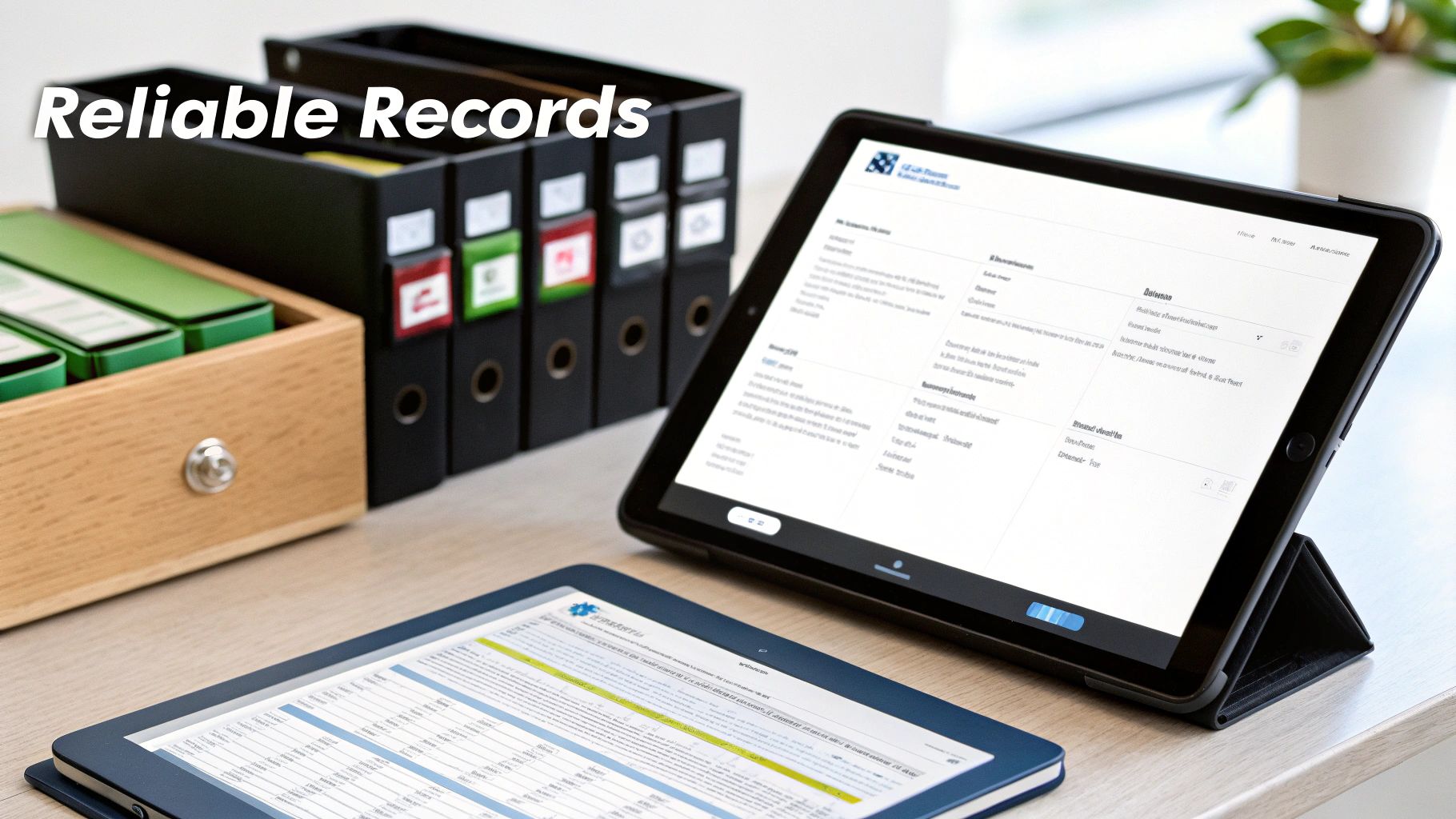
Even the most perfect template for donation receipt is only as good as the system that delivers and stores it. A messy, unreliable workflow can undermine donor trust and create massive headaches down the road. This operational side of receipt management is where your professionalism truly shines.
Sending a receipt promptly after a donation is a small act that makes a huge difference. In fact, donors who receive a personalized thank-you within 48 hours are four times more likely to give again. This immediate acknowledgment confirms their gift was received and appreciated, reinforcing the positive feeling they have about supporting your cause.
Choosing Your Delivery Method
Deciding between email and traditional mail often comes down to your donor base and what your organization can realistically manage. Each method has its own distinct advantages.
- Email Delivery: This is the go-to for many nonprofits because it's fast, cost-effective, and easy to automate. It's a natural fit for online donations and gives donors a digital copy they can save instantly.
- Traditional Mail: A physical receipt can feel more substantial and personal. It's often a great touch for older donors or as a way to acknowledge very large contributions. Of course, this route comes with printing and postage costs.
A hybrid approach often works best. You can use email for the majority of donations while reserving physical mail for major gifts or for donors who have specifically requested it. This strategy balances efficiency with a personal touch that can really stand out.
Whichever method you choose, consistency is key. A reliable delivery system shows your organization is organized, professional, and values every single contribution, no matter the amount.
Secure Digital Storage for Peace of Mind
Your responsibility doesn't end once the receipt is sent. Maintaining secure, organized records is non-negotiable for financial transparency and audit preparedness. A chaotic system can turn a simple information request into a frantic, time-consuming search.
Cloud-based storage solutions are a lifesaver here. They provide a secure, centralized location for all your donation records that you can access from anywhere. I recommend creating a clear folder structure—maybe organized by year and then by donor name—to ensure any specific receipt can be found in seconds.
For more in-depth strategies, our guide on how to organize receipts for taxes offers practical tips you can implement today. A robust storage system doesn't just save time; it ensures you're always ready for an audit.
Common Questions About Donation Receipts Answered
Once you have a solid template in place, a few practical questions almost always come up. Let's walk through some of the most common queries we hear from nonprofits and donors, so you can handle every situation with confidence.
Do I Really Need a Receipt for Small Donations?
Technically, tax law gets serious about gifts over $250. But from a relationship-building standpoint? Yes, you absolutely should send a receipt for every single donation.
Acknowledging a small gift shows every supporter they're valued, and that feeling is what encourages them to give again. Using an efficient tool makes this process quick, so you can thank everyone without drowning in admin work.
Is a Receipt the Same as an Acknowledgment Letter?
Not exactly, but they work beautifully together. Think of it this way: the receipt is the official, tax-required document with all the specific details. The acknowledgment letter is the personal thank-you note.
The best practice is often a hybrid: a heartfelt letter that seamlessly includes all the legally required receipt elements. This approach lets you meet your compliance needs while making your donor feel truly appreciated. For tracking smaller internal expenses, our guide on creating a petty cash receipt template might also come in handy.
Combining a sincere thank-you with the required tax information turns a transactional document into a meaningful touchpoint, reinforcing donor loyalty.
Can I Send One Annual Receipt for Recurring Donors?
Absolutely! In fact, this is a smart and efficient practice that many monthly donors actually prefer. It simplifies their own record-keeping come tax time.
You can issue a single, consolidated statement at the end of the year that itemizes each donation's date and amount. This saves your team a ton of time and gives your most loyal supporters one clean document to work with.
What if I Make a Mistake on a Receipt?
It happens to the best of us. The key is to correct it promptly and transparently.
If you spot an error on a receipt you've already sent, just create a new one with the right information. Be sure to clearly mark it as "Corrected" or "Amended" to avoid any confusion. For your own records, it's a good idea to keep a digital copy of both the original and the corrected version. This is great for transparency and will save you headaches if you're ever audited.
Ready to create flawless, professional receipts in minutes? With Receipt Maker, you can customize every detail, from your logo to tax statements, ensuring every donor receives a compliant and impressive document. Start creating your free receipts today