Create a Perfect Petty Cash Receipt Template in Minutes
Ditch messy paperwork. Our guide shows you how to create a perfect petty cash receipt template, manage funds, and track every small expense with confidence.

Think of a petty cash receipt template as a simple, standardized form that helps you track all the small cash expenses paid out from your company's petty cash fund. This little tool is what brings order to the chaos of minor purchases, making sure every dollar—from office coffee to postage—is recorded accurately. It’s the single source of truth for all your small-cash spending.
Why Petty Cash Is Still Essential for Your Business

Let's be honest, even as we move towards a cashless world, actual cash hasn't gone anywhere. Small, immediate expenses pop up every day in just about any business. A team member might need reimbursement for grabbing coffee for a client meeting, or a delivery driver might need a quick cash tip. These are the moments where fumbling with corporate cards or digital payments is just not practical.
This is precisely where a well-managed petty cash system shines. It’s a business necessity, not just a nice-to-have. Without it, these small expenditures can quickly turn into a financial black hole, leaving you with frustrating end-of-month reconciliations and wondering, "Where on earth did all that money go?"
The Role of the Petty Cash Receipt Template
A simple petty cash receipt template is the backbone of this whole system. It’s what transforms a messy pile of cash payments into a structured, accountable process. Each time someone fills out a receipt, it becomes another piece of the financial puzzle, creating a clear and verifiable audit trail for every dollar spent.
Having this documentation is crucial for a few key reasons:
- Accountability: It confirms who spent the money, what they bought, and who gave them the green light.
- Accuracy: It ensures your financial records are complete and reflect all business activities, no matter how small.
- Simplicity: It makes the reimbursement process painless and transparent for everyone involved, from employees to managers.
A disciplined approach to petty cash is a hallmark of a financially healthy business. It demonstrates that no expense is too small to be tracked, ensuring total visibility and control over company funds.
Despite the global shift to digital, cash is still a major player. In fact, cash still accounted for over $7.6 trillion in consumer spending back in 2022. That staggering number shows why managing physical cash is still a big deal and why tools like petty cash receipt templates are indispensable. You can learn more about the global role of cash from the 2023 FIS Global Payments Report.
Real-World Scenarios Where Petty Cash Shines
Imagine you're a film producer on a bustling set. An actor needs a last-minute prop from a local thrift store that only takes cash. Or maybe you're an office manager, and the postage meter unexpectedly dies right before a critical mailing needs to go out. In situations like these, petty cash is the fastest, most efficient solution.
For freelancers, it might be something as simple as paying for a parking meter at a client's office or buying a specific type of pen for a design project. Each of these scenarios highlights the need for a quick, accessible fund for minor expenses. A standardized petty cash receipt ensures that even these on-the-fly purchases are documented correctly, making tax time and client invoicing worlds easier.
What Makes a Petty Cash Receipt Airtight?
What’s the difference between a receipt that works and one that just creates more questions? The details. A solid petty cash receipt isn't just a slip of paper with a number on it; it's your frontline tool for keeping your cash fund accurate, accountable, and running smoothly.
Think of it as the story of a small transaction. Each part of the receipt provides a piece of that story. When all the pieces are there, you have a complete, clear record of where company money went and why. Let's walk through what every good petty cash receipt needs.
Below is a quick breakdown of the essential fields you absolutely need on your petty cash receipt. Each component plays a specific role in creating a clear financial record.
Essential Components of a Petty Cash Receipt
| Component | Purpose | Example |
|---|---|---|
| Receipt Number | Uniquely identifies each transaction, preventing duplicates and making it easy to track during audits or reconciliations. | #PC-0127 |
| Transaction Date | Records the exact date the purchase was made, which is crucial for matching expenses to the correct accounting period. | October 26, 2023 |
| Amount Paid | Clearly states the total cash disbursed. Including both numerals and words minimizes errors and prevents tampering. | $25.50 (Twenty-five dollars and fifty cents) |
| Paid To (Payee) | Specifies the individual who received the cash reimbursement, creating a clear line of responsibility. | Jane Doe, Sales Department |
| Expense Description | Explains the business purpose of the purchase in detail. This is vital for justifying the expense. | "Client coffee and pastries for Acme Corp meeting" |
| "Received By" Signature | The signature of the person who took the cash, serving as their acknowledgment of receipt. | [Signature of Jane Doe] |
| "Approved By" Signature | The signature of the manager or custodian who authorized the payment, confirming the expense is legitimate. | [Signature of John Smith, Office Manager] |
Having these components in place turns a simple form into a robust internal control document, protecting both the employee and the company.
Unique Identifying Information
First things first, every single receipt needs its own unique identity. This is non-negotiable. Without it, you're just asking for duplicate reimbursements and a messy audit trail. A pile of unnumbered, undated slips is an accounting nightmare waiting to happen.
The two most critical pieces of information here are:
- A Receipt Number: A simple sequential number (like #001, #002, and so on) is the easiest way to make sure no two vouchers are alike. It makes referencing a specific transaction later on a breeze.
- The Transaction Date: This isn't the date of the reimbursement, but the date the actual purchase was made. Getting this right is key for good bookkeeping, as it helps you slot the expense into the right accounting period.
These two small details provide the basic framework for everything else on the receipt.
The Financial Nitty-Gritty
Okay, now for the money part. This section is all about clarity. You want to avoid any confusion so that when it comes time to reconcile the fund, the numbers add up perfectly.
Your template has to nail these two fields:
- Amount Paid: State the total amount paid out from the petty cash box. I always recommend writing it in both numbers (e.g., $15.75) and words ("Fifteen dollars and seventy-five cents"). This old-school trick is great for preventing misinterpretation or even tampering.
- Paid To/Payee: Who got the money? Put their name and maybe even their department. This creates a chain of responsibility, showing exactly who handled the cash for that purchase.
The Story Behind the Spending
Just knowing that $25 was spent isn't enough. You need to know why. A vague description like "office supplies" is an accountant's worst enemy and can cause real headaches during a financial review.
This is where you tell the story. For example, instead of "Supplies," a much better entry would be "Printer paper and black ink cartridges for the marketing department." That level of detail immediately clarifies the business purpose and leaves no room for questions down the line.
The better your expense descriptions, the healthier your financial records will be. Vague notes create doubt; specific details build a record of trust and transparency.
Honestly, this might be the most important field on the whole receipt. It’s what justifies the purchase as a legitimate business expense. If you're looking for more ideas on how to structure your records, our guide on creating a free online receipt template has some great examples for all sorts of business needs.
Signatures for Accountability
The final piece of the puzzle is all about accountability. A couple of signatures can turn a simple form into an official internal document, confirming the transaction was legitimate, reviewed, and properly approved.
Every petty cash receipt you use should have signature lines for these two people:
- Received By: The person who actually received the cash signs here. This is them formally acknowledging they've taken the funds.
- Approved By: The manager or petty cash custodian who authorized the payout signs here. This confirms the expense was valid and green-lit.
These signatures add a crucial layer of internal control. They're proof that at least two people have seen and verified the transaction, which goes a long way in preventing misuse of the fund.
Building Your Custom Receipt with Receipt Maker
Alright, now that we've covered what goes on a petty cash receipt, let's get practical. You don't need to be a graphic designer to create a polished, professional petty cash receipt template. With a tool like Receipt Maker, you can build a form that perfectly matches your company’s workflow and brand, and you can do it right in your browser.
Forget fussing with a blank document. Modern receipt makers give you pre-designed templates that already have all the essential fields. Your job isn't to build from the ground up, but to tweak and personalize it for your specific needs.
It really comes down to a simple, three-part flow: get the details down, confirm the amount, and get it signed.
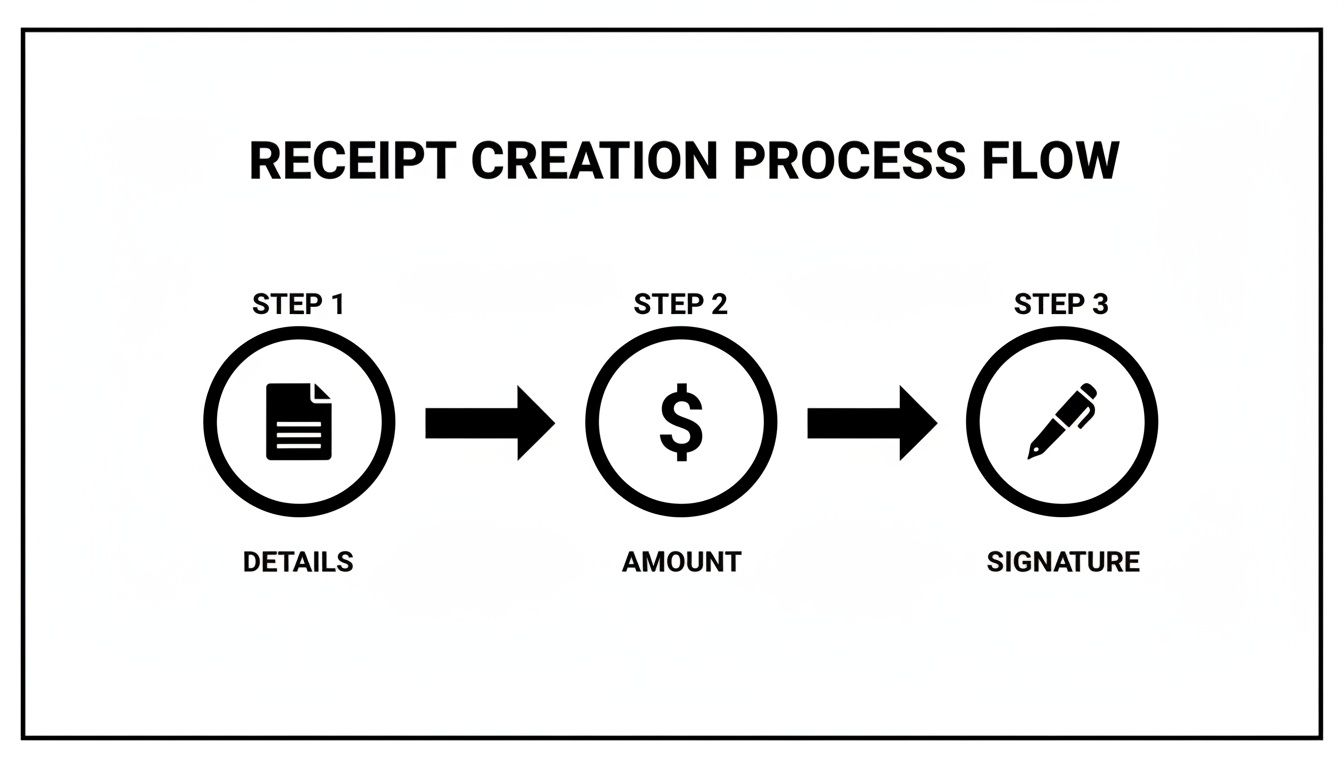
As you can see, making a compliant and professional receipt is incredibly straightforward. It just takes a little attention to these key areas to make the process fast and painless.
Starting with a Solid Foundation
First things first, you need to pick a base template to work from. Most receipt makers offer a whole gallery of options, often sorted by industry. For a petty cash slip, I've found that a simple "Service" or "Generic" template is usually the best starting point—it has all the core fields without any extra clutter you’ll just have to delete later.
Think of this as an efficiency play. By choosing a template that's already 90% of the way there, you save yourself a ton of editing time. You can then put your energy into the customizations that really count, like adding your company logo or fine-tuning the line items for common petty cash purchases.
Branding Your Receipt for a Professional Look
Want to instantly make your petty cash slip look less like a random piece of paper and more like an official company document? Add your logo. It’s a small detail that adds a huge layer of credibility and reinforces your brand. In Receipt Maker, this is typically a simple drag-and-drop or upload process.
A few quick tips from experience:
- Use a high-resolution logo. Nothing screams "amateur" like a blurry, pixelated image. Make sure it’s crisp and clean.
- Position it prominently. The top-left or top-center is standard for a reason—it’s the first thing someone sees.
- Check for legibility. If your logo has text, make sure you can still read it when it's scaled down to fit on the receipt.
A branded receipt isn't just about tracking an expense. It sends a message that even small, everyday transactions are handled with professional care.
Even as digital payments take over, the need for airtight tracking of small cash expenses has actually become more critical. The global share of cash transactions dropped by nearly 4 percentage points in 2022 alone, which means the cash that is still floating around needs to be managed flawlessly. A browser-based petty cash receipt template generator really shines here, letting you create custom receipts on the fly for those oddball expenses, like last-minute props for a video shoot or tips for a delivery driver.
Customizing Fields and Line Items
This is where you make the receipt truly your own. A good tool will let you click into and edit every field. You can easily change a generic label like "Item" to something more specific like "Expense Description," or maybe add a custom field for "Department Code" if that helps your accounting team.
Then, think about your most common petty cash expenses. If your office staff is constantly running out for supplies, you could create a template that has line items already set for things like:
- Office Supplies: Pens, paper, ink cartridges
- Employee Reimbursements: Morning coffee run, parking meter fees
- Postage & Shipping: Stamps, courier services
Getting this granular ensures consistency across all receipts and makes the reconciliation process at the end of the month a whole lot faster for whoever manages the cash box.
Adding Signature Lines and Final Touches
Accountability is the name of the game with petty cash. Your custom template absolutely must have clear signature lines. Most generators let you add simple text boxes or horizontal lines at the bottom. I always recommend setting up two distinct spots:
- "Received By" Signature: This is for the employee taking the cash.
- "Approved By" Signature: This is for the manager or petty cash custodian who authorized it.
Finally, think about the little aesthetic touches. Some tools, like Receipt Maker, let you add effects like a thermal paper look or use different fonts to give your digital receipt a more authentic, printed feel. While you probably don't need this for internal forms, it can be a lifesaver for specific scenarios, like creating realistic props for a film or a play.
Ready to give it a shot? You can start building your own template right now using our free receipt maker.
By spending just a few minutes setting up a custom petty cash receipt, you create a standardized, professional tool that will streamline your expense tracking for years to come.
Smarter Petty Cash Management and Record Keeping
Having a good petty cash receipt template is a great starting point, but it's just one tool in your toolbox. To build a system that actually works and doesn't give you a headache, you need to pair that template with smart management habits.
Without a solid process, even the slickest template won't stop the usual problems: missing cash, sloppy records, and painful month-end reconciliations. Think of it this way: your template is the car, but your management practices are the rules of the road. They keep everything moving safely and build a system that’s secure, transparent, and simple to manage.
Establish a Fixed Fund Amount
The gold standard for any disciplined petty cash system is the imprest system. It sounds complicated, but the idea is simple: you set a fixed amount for your petty cash fund—say, $200—and that’s your baseline. This amount is called the float.
When you need to top up the fund, you only add back the exact amount that was spent. So, if you have $45 in receipts, you put exactly $45 back in cash. This creates a beautifully simple, self-balancing equation: the cash in the box plus the total on your receipts should always equal your original $200 float.
This approach makes it incredibly easy to spot problems. If the numbers don't add up, you know instantly that a receipt is missing or a mistake was made, letting you sort it out before it gets lost in the shuffle.
Set Crystal Clear Expense Rules
Vague rules are a recipe for disaster in financial management. It’s crucial to establish and communicate clear, written guidelines on what petty cash can and can't be used for. This stops employees from making unapproved purchases and takes the guesswork out of the equation.
Your policy needs to spell out:
- Approved Expense Categories: Be specific. Can it be used for office supplies, postage, and client coffee runs? List them out.
- Spending Limits: Set a clear cap for any single purchase, like $50. Anything bigger should go through your normal purchasing process.
- Prohibited Items: Explicitly state what the fund can't be used for. Think personal items, alcohol, or cashing personal checks.
Getting these rules down in black and white protects the company and the employee. Everyone knows exactly where they stand.
A well-defined policy is your first line of defense against misuse. It transforms petty cash from a potential liability into a controlled, predictable tool for managing minor expenses.
Secure Your Cash and Records
This might sound like a no-brainer, but physical security is absolutely key. The cash and your blank petty cash receipt template forms should always be kept in a locked box or drawer.
Even better, restrict access to a single person—the petty cash custodian. This individual is responsible for handing out cash, collecting receipts, and keeping the log updated. By limiting access, you create a clear line of accountability. If something goes wrong, you know exactly who to talk to. This one step can dramatically cut down the risk of theft or unauthorized use.
Master the Reconciliation Process
Regular reconciliation is where you prove your system works. You should get into a consistent rhythm of doing this, whether it's weekly or bi-weekly. The whole point is to make sure your cash and receipts balance back to your original float.
Here’s how it works in practice:
- Start with your float: Let's stick with our $200 example.
- Count the cash on hand: You open the box and count $88.
- Total your receipts: You add up all the completed petty cash slips, and the total comes to $112.
- Do the math: $88 (cash) + $112 (receipts) = $200. Perfect. Everything balances.
But what if the total was $195? You'd know right away you have a $5 shortfall that needs investigating. Catching these small issues early is what prevents them from becoming big headaches later.
For a deeper dive into financial tracking, our guide on how to track business expenses has more tips that work hand-in-hand with a solid petty cash system. This kind of consistent oversight is what helps a business breeze through tax season without that last-minute scramble.
Getting Your Receipt Printed, Shared, and Filed Away
Alright, so you've crafted the perfect petty cash receipt. Now what? The final, crucial step is to get that receipt out of the generator and into the real world, whether that's a physical cash box or a digital archive. How you export and print it can make a real difference in keeping your records clean, professional, and easy to manage.
Think about where this receipt is headed. Are you emailing it to a colleague? Printing a hard copy to go with the cash? Or are you saving it for your year-end audit? Each of these situations calls for a slightly different approach.
What’s the Best File Format for Your Receipt?
When you go to save your receipt, you'll usually get a few options like PDF, PNG, or JPEG. They might seem similar, but trust me, they're not interchangeable. Choosing the right one ensures your receipt looks sharp and professional every time.
Here's my take on when to use each:
- PDF (Portable Document Format): This is your go-to for printing, hands down. PDFs lock in the layout, fonts, and quality, so what you see on your screen is exactly what comes out of the printer. For a crisp, professional hard copy, you can't beat a PDF.
- PNG (Portable Network Graphics): Perfect for digital sharing. If you're emailing a receipt or dropping it into a Slack channel, a PNG keeps the quality high without being a massive file. It's also great if you ever need a transparent background.
- JPEG (Joint Photographic Experts Group): This format is all about small file sizes. It's handy if you're uploading receipts to a web portal or are tight on storage space. Just be aware that JPEGs can sometimes sacrifice a little bit of text clarity, so I'd avoid them for high-stakes printing.
For most day-to-day petty cash tracking, PDF is the safest and most reliable bet. It just works.
Printing Tips for That Authentic Receipt Feel
The way you print your receipt can also make a difference, especially if you're trying to replicate a lost original for your records. Standard 8.5" x 11" office paper is fine for internal filing, of course. But sometimes you want it to look and feel like it just came out of a cash register.
For that classic receipt vibe, try printing on an 80mm thermal paper roll. You can find them easily online. Many receipt tools, including Receipt Maker, offer templates specifically designed for this size. Printing on a thermal roll instantly gives your document that familiar, legit look of a real point-of-sale slip.
At the end of the day, a receipt—generated or original—is meant to be a clear, undeniable record of a transaction. Using the right format and printing method just adds to its credibility and makes sure it holds up during reconciliation or an audit.
A Quick Word on Compliance
This brings us to the most important point: staying compliant. A petty cash receipt template is an incredibly useful tool for accurate bookkeeping, but it has to be used responsibly. These templates are meant for legitimate business needs, like properly tracking expenses or creating a record for a genuinely lost receipt.
Remember, tax authorities demand clear proof for every single business expense you claim. Keeping a detailed, organized file of your petty cash receipts—digital or physical—isn't just a good habit; it's a legal requirement. Each little slip is a piece of evidence that justifies an expense and shows you’re managing company funds properly.
Ultimately, you're creating an audit trail that protects your business. By making sure every small cash payment is backed by a complete and accurate receipt, you're building a financial system that can withstand scrutiny.
Quick Answers to Common Petty Cash Questions
Let's face it, managing petty cash can bring up some tricky situations. You want to keep things organized and by the book, but small cash transactions can get messy. To help you out, I've put together answers to the most common questions people ask about managing a petty cash fund.
Think of this as your go-to guide for those real-world moments—like when a receipt goes missing or you're wondering if a simple notebook log is good enough. These insights are pulled from years of experience in keeping financial records clean and making sure the reimbursement process is always smooth.
What’s the Point of a Petty Cash Receipt?
At its heart, a petty cash receipt is your internal proof of purchase for small cash expenses. It’s the form you use to document a payment from the company’s petty cash box, especially when a standard store receipt isn't available. We're talking about things like paying for postage, tipping a delivery driver, or reimbursing someone for buying coffee for a meeting.
This little piece of paper is a big deal for your accounting. It creates an official record that allows your finance team to track every small expense, balance the fund, and make sure company money is spent on legitimate business needs. A good receipt always has the date, amount, reason for the expense, and signatures from the person receiving the cash and the person approving it. That’s accountability.
A petty cash receipt is the internal control that steps in when an external one (like a store receipt) is missing. It keeps the audit trail complete, ensuring every dollar is accounted for, no matter how small the transaction.
What Do I Do If the Original Receipt Is Gone?
This happens all the time, and it's precisely why having a petty cash receipt template is a lifesaver. An employee makes a valid purchase for the business but loses the vendor receipt. Or maybe one was never issued in the first place, like with a parking meter or a small cash-only purchase at a market.
You don't just have to write off the expense. Instead, you have the employee fill out one of your internal petty cash receipt forms. They’ll need to jot down all the key details: what they bought, why they needed it, the date, and the exact amount spent. Then, they sign it to confirm the information is true.
The person in charge of the petty cash fund then reviews the form, hands over the cash reimbursement, and signs off on it as approved. Just like that, your internal document officially stands in for the missing one, keeping your financial records complete and compliant.
Can’t I Just Use a Handwritten Logbook?
Look, a handwritten log is definitely better than nothing. But if you want to manage your funds professionally, a standardized template is the only way to go. A consistent format for every single transaction is a cornerstone of solid financial management.
Here’s why it makes a huge difference:
- Consistency: A template forces everyone to capture the same crucial information every time. You'll never have to chase someone down for a missing signature or a vague expense description again.
- Professionalism: It sends a clear message that petty cash is taken seriously—it's not just a spare cash drawer. This subtle cue encourages your team to be more responsible with their spending.
- Efficiency: Using a tool to generate your petty cash receipt template means you can create and print new forms in seconds. Digital templates can be saved as PDFs for electronic filing, which makes finding a specific record for an audit way faster than flipping through a dusty old notebook.
Ultimately, a dedicated template turns a simple chore into a structured, reliable process.
Ready to create a professional, consistent system for your small expenses? With Receipt Maker, you can design a custom petty cash receipt template in minutes, ensuring every transaction is perfectly documented. Start building your free template today.