Your Complete Guide to the Standard Taxi Receipt Format
Master the essential taxi receipt format for expense reports. Our guide covers key details, real-world examples, and compliance tips for perfect receipts.

Think of a proper taxi receipt as more than just a slip of paper. It's your financial passport for a business trip, a structured document that proves you spent what you say you spent. Without the right details, an expense claim can get shot down in a heartbeat.
What a Valid Taxi Receipt Format Actually Looks Like
We're long past the days when a hastily scribbled note from a cab driver would pass for proof of travel. Today, a valid receipt—whether it’s a printed slip from a thermal printer or a digital confirmation in your inbox—is a detailed record. It's exactly what finance teams and, more importantly, tax authorities need to see.
This shift isn't just about going digital. It's about a bigger demand for transparency and accountability in how company money is spent. Every single field on a modern receipt has a job to do, and together, they tell the verifiable story of your trip.
Key Components of a Modern Receipt
A compliant taxi receipt format needs to have several non-negotiable pieces of information. Think of them as the essential ingredients. If you're missing even one, you risk delays in getting your money back or, worse, problems during an audit.
Here’s what absolutely has to be there:
- Business Information: The official name and contact info for the taxi or ride-hailing service.
- Trip Details: The exact date, along with pickup and drop-off times.
- Route Information: Clear pickup and drop-off addresses are crucial for proving the trip was for business.
- Fare Breakdown: An itemized list is best. It should show the base fare, charges for distance or time, any tolls, and other surcharges.
- Total Amount Paid: The final, all-in cost, including any tip you added.
A complete and accurate receipt is the bedrock of a smooth expense report. It leaves no room for questions and gives your finance department the clear, auditable trail they need for reimbursement and compliance.
This kind of structured format creates an undeniable record of your expense. For anyone who manages or submits expenses, knowing what to look for is the first step in making sure every travel claim sails through without a problem. It’s about protecting both yourself and the company from any potential mix-ups.
Deconstructing the Perfect Taxi Receipt
Ever tried to submit an expense claim only to have it bounced back? It’s frustrating, and often, the culprit is a flimsy or incomplete receipt. Think of a proper taxi receipt as a complete story. Each piece of information—the date, the route, the cost—is a chapter that, when put together, tells a clear, verifiable story of your business trip.
Leave a chapter out, and the story falls apart. Your manager, or worse, a tax auditor, is left with questions. Let's break down the anatomy of a rock-solid taxi receipt, piece by piece, to see what makes it compliant and why every detail matters.
Mandatory Fields for Compliance
For any taxi receipt to be taken seriously, it has to include a few non-negotiable details. These are the absolute must-haves that prove the trip was legitimate and the expense is real.
- Taxi Company Information: This is your proof of purchase. The company’s official name, address, and phone number show you dealt with a real business.
- Driver or Vehicle ID: A unique identifier, like a taxi medallion number or the driver's ID, links the receipt directly to a specific vehicle and licensed operator.
- Date and Time: You need both. The pickup and drop-off times confirm the trip happened when you said it did, aligning with your work schedule or other travel itinerary items.
- Pickup and Drop-off Locations: Vague descriptions like "downtown to airport" don't cut it. You need precise addresses to justify the trip's purpose and route.
- Itemized Fare Breakdown: This is where the numbers get crunched. A good receipt clearly separates the base fare from charges for distance, time, tolls, or any other surcharges. No one likes a mystery fee.
The standardization of the taxi receipt format isn't just about picky accountants; it's about turning a simple slip of paper into a crucial financial document. It's no surprise that receipts in the US, Europe, and Asia are now expected to list at least eight key data points, including fare, tips, and payment method. If you're curious, you can learn more about these global receipt standards and why they’re so important for business expenses.
This simple infographic below shows just how far we've come—from a scribbled paper note to a key document ready for expense validation.
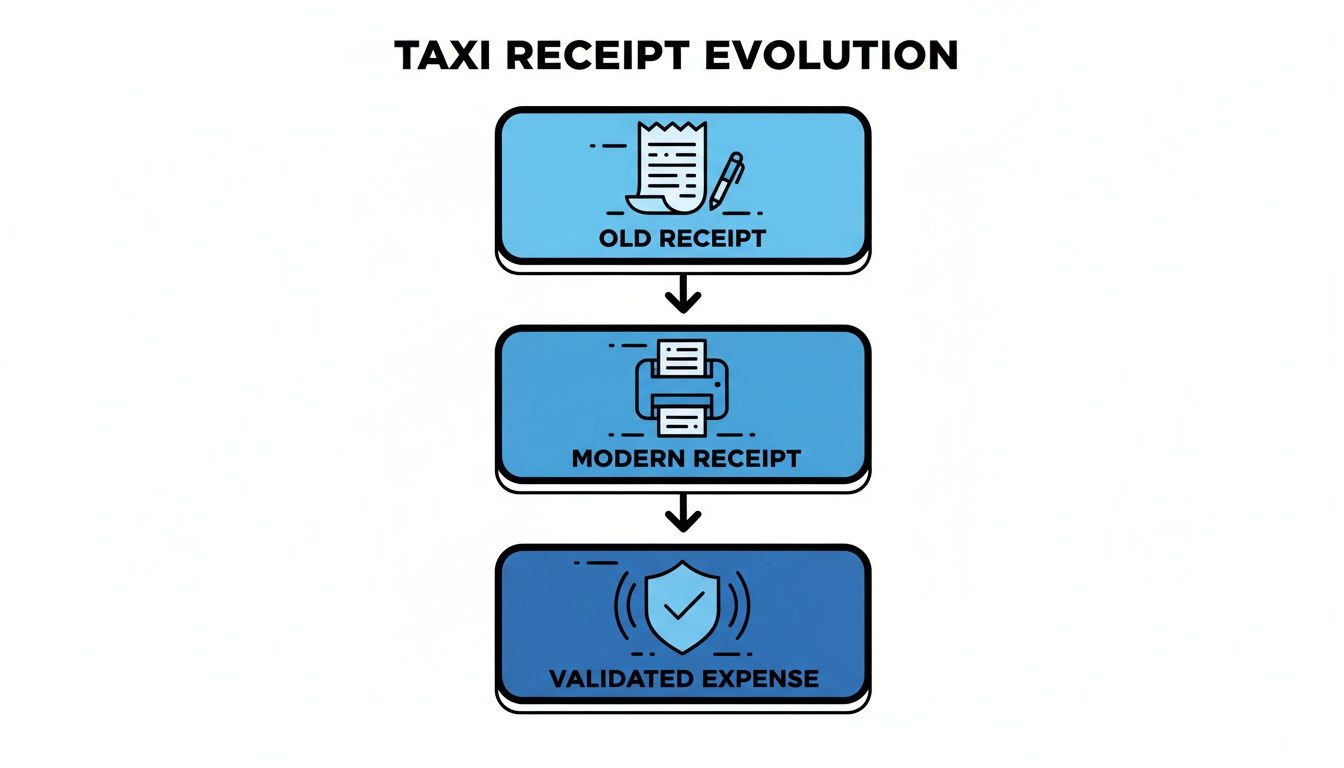
You can see the progression perfectly: from a basic, often handwritten proof to a structured document that plugs right into modern financial systems for easy verification.
Essential vs Optional Taxi Receipt Elements
To make things even clearer, let's break down what's absolutely essential versus what's just good practice. Getting the essentials right is key for compliance, while the optional details can save you from a lot of back-and-forth with the finance department.
| Component | Importance | Why It's Needed |
|---|---|---|
| Taxi Company Details | Essential | Proves the transaction was with a legitimate business. |
| Driver/Vehicle ID | Essential | Connects the trip to a specific, identifiable operator or vehicle for verification. |
| Date & Time | Essential | Confirms the trip occurred within the context of business activities. |
| Pickup & Drop-off | Essential | Justifies the business purpose of the trip and the route taken. |
| Itemized Fare Breakdown | Essential | Provides a transparent view of all charges, preventing questions about the total cost. |
| Tip Amount | Optional | Helps with company-specific expense policies on gratuities and ensures clear accounting. |
| Receipt/Transaction # | Optional | Offers an extra tracking reference for both you and the finance team if any issues arise. |
| Payment Method | Optional | Simplifies reconciliation with bank or credit card statements. |
Ultimately, the more detail you can provide, the stronger your expense claim becomes. A well-detailed receipt is a self-explanatory receipt.
Valuable Optional Details
Want to make your expense report bulletproof? Adding a few extra details can make the reimbursement process go from slow and painful to quick and easy.
A detailed receipt leaves no room for doubt. Including optional information like the tip amount and a receipt number builds a stronger, more transparent record of the expense.
Here’s why these extras are so helpful:
- Tip Amount: Many companies have specific rules about tipping. By listing the tip separately, you make it easy for the finance team to see you’re following policy.
- Receipt or Transaction Number: This unique ID is your best friend if there's ever a question about the charge. It's an easy way for anyone to track down the specific transaction.
- Payment Method: Noting whether you paid with cash, a corporate card, or a digital wallet helps everyone match the receipt to the right financial statement.
When you're trying to create a replacement for a lost receipt, paying attention to these small details is what separates a questionable document from one that sails through approvals. It's a small effort that saves a lot of time and hassle down the road.
Real-World Taxi Receipt Formats
It's one thing to know what should be on a taxi receipt, but it's another to know what you're looking at when you get one. Taxi receipts aren't standardized; they come in all shapes and sizes, depending on the taxi company, the tech they use, and even where you are in the world.
From the classic paper slip handed to you by a cabbie to a detailed email from a rideshare app, you'll run into a few common types. The most old-school is the carbon copy slip, which you don't see much anymore. More common is the thermal paper printout—that flimsy, shiny paper that comes out of a small dashboard printer.
Of course, digital receipts are now king, especially with ride-hailing services. They land in your email or app moments after your ride ends, giving you a perfect, permanent record. While they all look different, they should all contain the same core information.
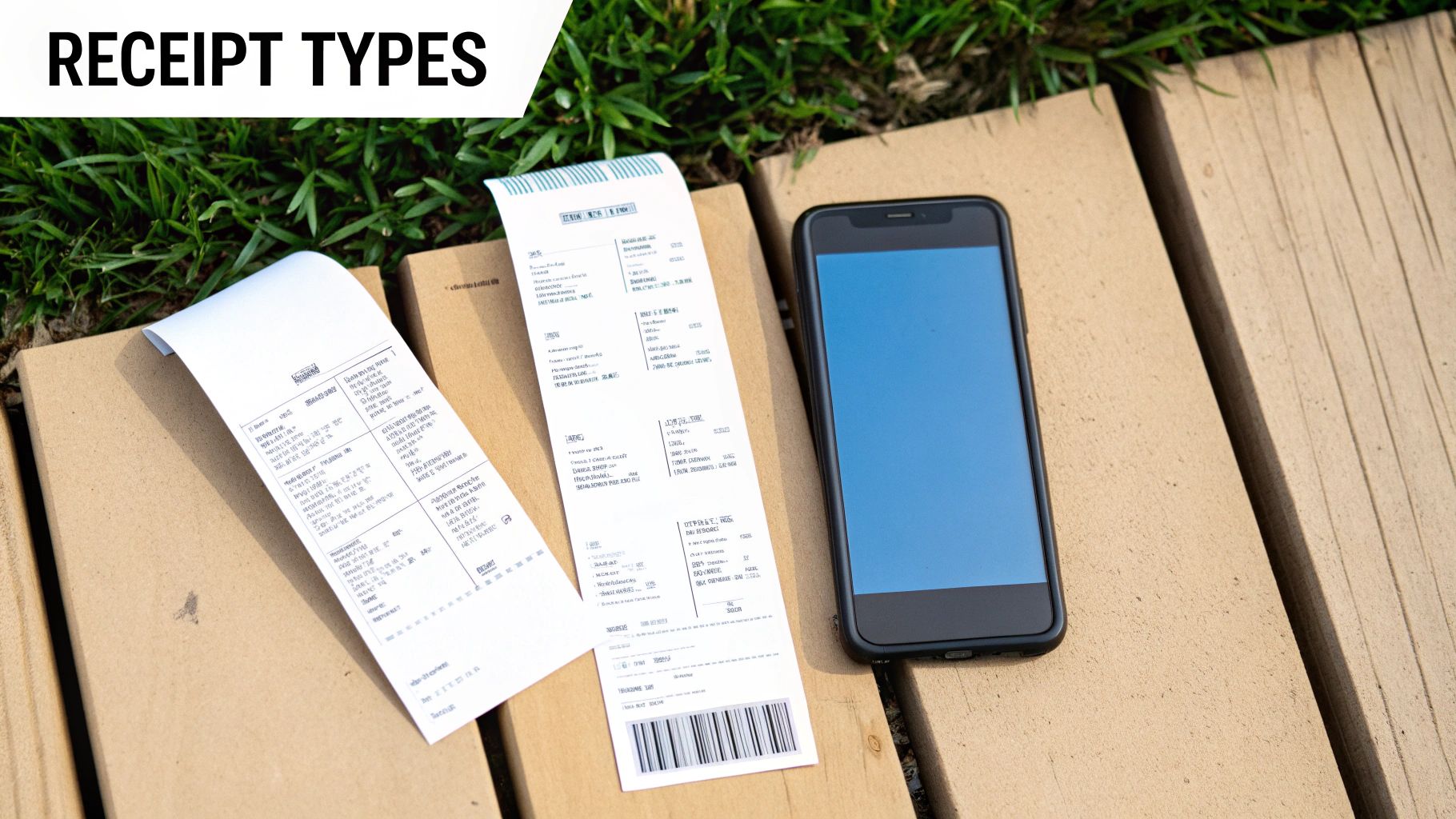
The Classic Thermal Printout
This is what most people picture when they think of a taxi receipt. They're typically printed on narrow, 80mm thermal paper and can look a bit cramped. But don't let the clutter fool you; all the essential info is usually there if you scan for it.
Look for the company name right at the top, followed by the trip date, time, and the cab or medallion number. The most important section is the fare breakdown. It should show a list of charges—the base fare, distance, time, tolls, and tip—that add up to the final total. Make sure it's itemized, not just a single lump sum.
A good thermal receipt has a clean layout. The business details are prominent, and a simple table structure breaks down the fare. This makes it a breeze for an accounting department to quickly review and approve.
The Modern Digital Receipt
Digital receipts from apps like Uber and Lyft have really raised the bar. They’re designed for screens, so they're clean, easy to read, and packed with details that paper receipts could never include, like a map of your exact route.
The biggest win with digital receipts is the sheer amount of detail. With a trip map, payment method, and precise start and end times, they create a bulletproof record for any expense claim.
Because these receipts are generated and saved automatically, you never have to worry about digging a crumpled piece of paper out of your pocket. For a perfect example of what a modern receipt looks like, check out this sample Lyft receipt for a downtown commute. You can see how clearly everything is laid out.
This is exactly why finance teams love them. There’s no ambiguity, no missing information, and no smudged ink.
The Journey from Paper Scraps to Digital Records
The humble taxi receipt has come a long, long way. What started as a scribbled note on a scrap of paper—often just as a courtesy—has transformed into a vital financial document. In the early days, there was no such thing as a standard taxi receipt format, which made tracking expenses feel like a game of guesswork.
This evolution from a simple IOU to a detailed printout perfectly mirrors the world’s growing need for financial transparency. As businesses expanded and travel became a routine part of work, a simple handwritten fare just wouldn't cut it anymore. Accountants and tax auditors needed something real, something consistent.
From Handwritten Fares to Printed Proof
The first big change came with mechanical meters and, later, the in-vehicle printers we’re all familiar with. This brought a much-needed layer of consistency to the chaos. If you look at old New York City taxi receipts, you can see a fascinating economic history unfold right on the paper. Back in July 1952, the meter started at just $0.20, with another $0.05 for every quarter-mile. Fast forward to July 1984, and that same ride started at $1.10 for just the first 1/9th of a mile—a clear picture of decades of inflation and rising costs. You can dive deeper into this historical fare data to see how it shaped receipt details.
This backstory is important because as fare structures got more complicated, the receipts had to keep up. They needed to clearly itemize every charge, setting the stage for the detailed layouts we expect today.
The Digital Revolution in Fare Documentation
Then came the ride-hailing apps, and everything changed again. Suddenly, the default was a digital receipt sent straight to your inbox. This wasn't just about convenience; it was a game-changer for anyone managing expenses.
The move to digital receipts fundamentally changed how we handle travel expenses. It eliminated lost paper slips, automated data entry, and provided an unalterable, detailed record of every trip.
This digital shift has had a massive ripple effect, making things more efficient and even a little greener.
- Reduced Paper Waste: Think of the millions of thermal paper printouts saved every year.
- Simplified Expense Filing: Now, employees can just forward an email or sync their apps directly with accounting software. No more scanning tiny slips of paper.
- Enhanced Data Tracking: Companies can finally get a clear, organized view of where their travel budget is going.
This entire journey underscores why a proper, standardized format is so important. Whether it's printed on the spot or emailed to your phone, a modern taxi receipt is a crucial tool for anyone who needs to properly track business expenses. The evolution from a simple paper note to a data-rich digital file is really a story about the broader push for accuracy and accountability in business.
How to Create a Compliant Taxi Receipt
We’ve all been there—that sinking feeling when you realize you’ve lost a taxi receipt you desperately need for an expense report. It's a common headache, but creating a compliant replacement is surprisingly straightforward if you know what you’re doing. This isn't about making things up; it's about accurately reconstructing a record of a legitimate business expense you already paid for.
Think of it like putting together a puzzle. You already have all the important pieces of information from your trip: the date, where you went, and how much you paid. The trick is simply assembling them into the correct taxi receipt format. Using a reliable tool ensures every piece falls into place, creating a document that’s both accurate and professional.

Step 1: Start with a Professional Template
The foundation of any believable receipt is its layout. Instead of trying to build one from scratch in a word processor, it’s far easier to start with a pre-designed taxi receipt template. This gives you a head start, ensuring all the essential fields are already in place and professionally arranged. Right away, your document looks credible and authentic.
Most tools offer a few different layouts to choose from. You can learn more about how different styles suit various needs in our guide to using a free online receipt template. Picking the right one saves a ton of time and is the first step toward guaranteeing compliance.
Step 2: Customize Company and Trip Details
Once you've got your template, it's time to plug in the specific details of your trip. Accuracy is everything here.
Start with the taxi company’s information, like its name and business address. Then, move on to the precise details of the ride itself.
- Date and Time: Be specific. Enter the exact date and the pickup and drop-off times.
- Trip Locations: Write out the full pickup and drop-off addresses. This helps validate the business purpose of your journey.
- Driver/Vehicle ID: If you happen to have the driver’s ID or the taxi’s medallion number, adding it provides an extra layer of authenticity.
Step 3: Itemize the Fare and Payment
A single lump-sum total can sometimes raise a red flag on an expense report. A truly compliant receipt needs a clear, logical breakdown of the total cost. It’s this transparency that finance departments are really looking for.
Carefully list out each component that made up the final fare:
- Base Fare: The flat fee just for getting in the cab.
- Distance/Time Charges: The cost calculated based on how far or how long you traveled.
- Tolls and Surcharges: Don't forget any extra fees incurred along the route, like bridge tolls or airport fees.
- Tip: The gratuity you gave the driver for their service.
Finally, note the payment method you used, whether it was cash, a credit card, or something like Apple Pay. This little detail is crucial for helping your accounting team reconcile the expense against company statements.
The goal is to create a document that tells a complete and verifiable story of your transaction. An itemized fare and clear payment details leave no room for questions.
Step 4: Refine and Download Your Receipt
The final touches are all about making the receipt look authentic. It's the small details that can make a huge difference. Consider adjusting the font to something that mimics what a thermal printer would use, or even apply a subtle paper texture effect for a touch more realism. This is the step that transforms your data into a believable document.
Once you’re happy that all the information is correct and the look is professional, you're ready to download. Most tools let you export a PDF, which is perfect for printing or attaching to a digital expense report. This final step gives you a compliant document that’s ready for submission.
Why a Proper Receipt Format Is Non-Negotiable
Trying to get an expense claim approved with a shoddy, incomplete receipt is a bit like showing up to the airport with a boarding pass scribbled on a napkin. It just isn't going to work. Your finance department, and certainly any tax authority, needs clear, standardized proof that a business expense is legitimate. That’s precisely what a proper taxi receipt format provides.
Without it, you’re looking at your reimbursement getting delayed or flat-out denied. And this isn't about accountants being needlessly picky; it's about keeping a clean, auditable paper trail. Think about it from their perspective: a receipt with a missing date, a smudged fare, or no breakdown of the charges is just a big question mark. In the world of finance, question marks are red flags.
Global Standards and Compliance
This isn't just a local issue, either. The basic requirements for a valid receipt are pretty much the same whether you're hailing a cab in London, Tokyo, or New York. An accurate, complete, and clearly laid-out receipt speaks a universal language that every finance professional understands.
An incomplete receipt isn't just a minor inconvenience—it's a potential compliance risk. Ensuring every detail is present protects both the employee and the company from future audit issues.
The move toward digital has only raised the stakes. We’ve seen a huge jump in the adoption of digital receipts worldwide. In some Asian megacities, they’ve achieved almost 100% digital compliance since 2020, cutting down on paper waste and making documentation easier to verify. If you're curious, you can learn more about this shift to hybrid receipt models and what it means for businesses and freelancers.
This evolution just drives the point home: every single receipt you create or submit has to be complete, readable, and in line with accepted financial practices.
Got Questions? We’ve Got Answers on Taxi Receipts
Even when you know what a taxi receipt should look like, the real world can throw you a curveball. Let's tackle some of the most common questions that pop up when you're on the road.
What if the Driver Can't Give Me a Receipt?
It happens. The printer’s out of paper, the system is down, or maybe they just don't have one. Don't sweat it. The key is to act quickly and create your own record of the trip right away.
Jot down everything you can remember:
- The taxi company's name
- The cab or medallion number (if you can see it)
- The date and time of your ride
- Your pickup spot and final destination
- The total amount you paid
When you pair these notes with the matching transaction on your credit card statement, you'll usually have enough proof to get your expense report approved.
Is My Credit Card Statement Good Enough on Its Own?
Probably not. While your credit card statement is great for proving you paid for something, it's missing the details your company's finance department needs. It doesn't show the route, the breakdown of the fare, or other specifics that prove the expense was legitimate and within company policy.
Think of it this way: a credit card statement confirms that you spent the money, but a proper receipt confirms what you spent it on. That little difference is everything when it comes to business expenses.
Are Digital Receipts from a Taxi Legit?
Absolutely. Digital receipts are not only legally valid but are quickly becoming the standard. As long as a digital receipt contains all the same essential information as a paper one—company details, fare, date, etc.—it's perfectly acceptable for both company expenses and tax purposes.
How Can I Tell if a Receipt is Fake?
Spotting a fake or doctored receipt is all about looking for things that just feel... off. Keep an eye out for tell-tale signs of a forgery.
Check for weird formatting, like mismatched fonts, text that doesn't line up correctly, or typos in the company's name or address. Then, use your common sense. Does the fare seem way too high or low for the distance you supposedly traveled? Any obvious red flags are a good reason to question the receipt's authenticity.
Creating professional, accurate receipts shouldn't be a headache. With Receipt Maker, you can generate a perfect taxi receipt in just a few clicks, making sure your expense reports are always spot-on. Get started for free at receiptmakr.com.