Your Guide to the Perfect Receipt Template for Car Sale
Create a legally-sound car sale document with our guide. Get a free receipt template for car sale, learn essential fields, and avoid common pitfalls.
When you're selling a car, a proper receipt template for car sale is more than just a piece of paper—it's your legal proof of the transaction. This document officially transfers ownership and is the single most important thing protecting both you and the buyer from headaches down the road. Think of it as the final, legally binding chapter of the deal, confirming payment and the vehicle's accepted condition.
Why a Handshake Just Won't Cut It
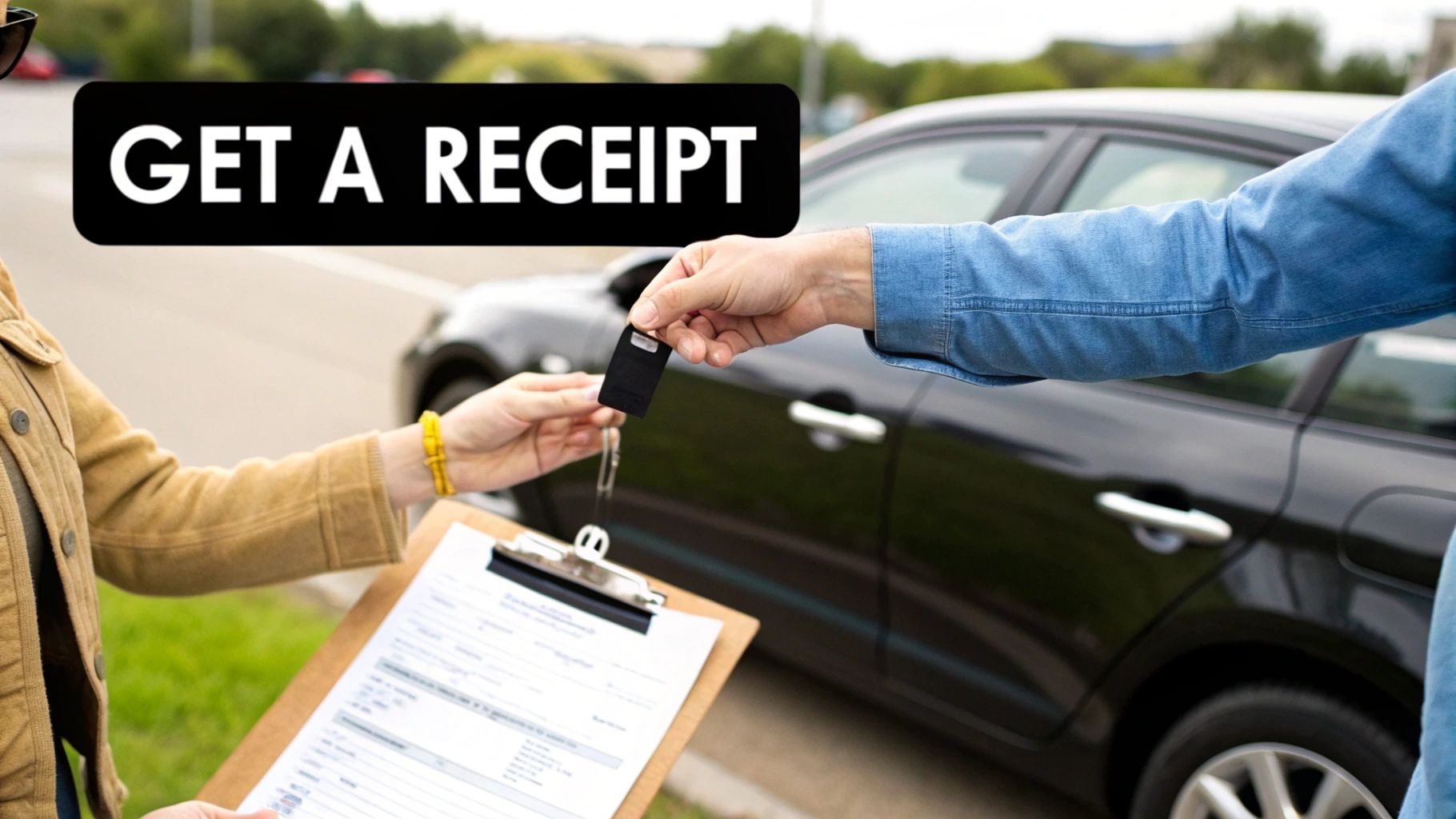
Selling a vehicle isn’t like selling old furniture at a garage sale. A handshake might feel honorable, but it offers zero legal protection when something goes wrong. A detailed, signed car sale receipt is the only thing that creates an undisputed record of the transaction for everyone involved.
If you’re the seller, that receipt is your official release from all future liability. Let's say the buyer gets a speeding ticket or, worse, gets into an accident an hour after they drive off your property. Without a receipt showing the exact date and time of sale, you could be stuck proving the car wasn't yours anymore. It can get messy, fast.
For the buyer, that receipt is everything. It's the key piece of evidence you'll need at the DMV to get the car registered and the title transferred into your name. No receipt? You’ve basically bought a very large, expensive paperweight you can't legally drive.
The Makings of an Ironclad Receipt
A good car sale receipt turns a simple document into a protective legal shield by capturing a few critical details. It’s not just about jotting down a price; it’s about creating a clear, complete picture of the deal that leaves no room for confusion.
Here’s what makes it work:
- Proof of Transaction: It confirms the exact sale price and how it was paid, shutting down any future arguments about money owed.
- Vehicle Identification: The Vehicle Identification Number (VIN), make, model, and year are non-negotiable. This information ties the receipt directly to that specific car.
- Ownership Transfer: Clearly stating the full names of the buyer and seller, along with signatures from both, is what legally documents the ownership changing hands.
A car sale receipt is your first line of defense. It’s the story of the transaction, written down and signed, ensuring both parties are protected long after the deal is done.
This guide will show you exactly how to create a receipt that does its job. By the way, if you’ve ever lost important documents, our guide on how to get copies of lost receipts has some great tips for tracking them down.
What Makes a Car Sale Receipt Truly Ironclad?
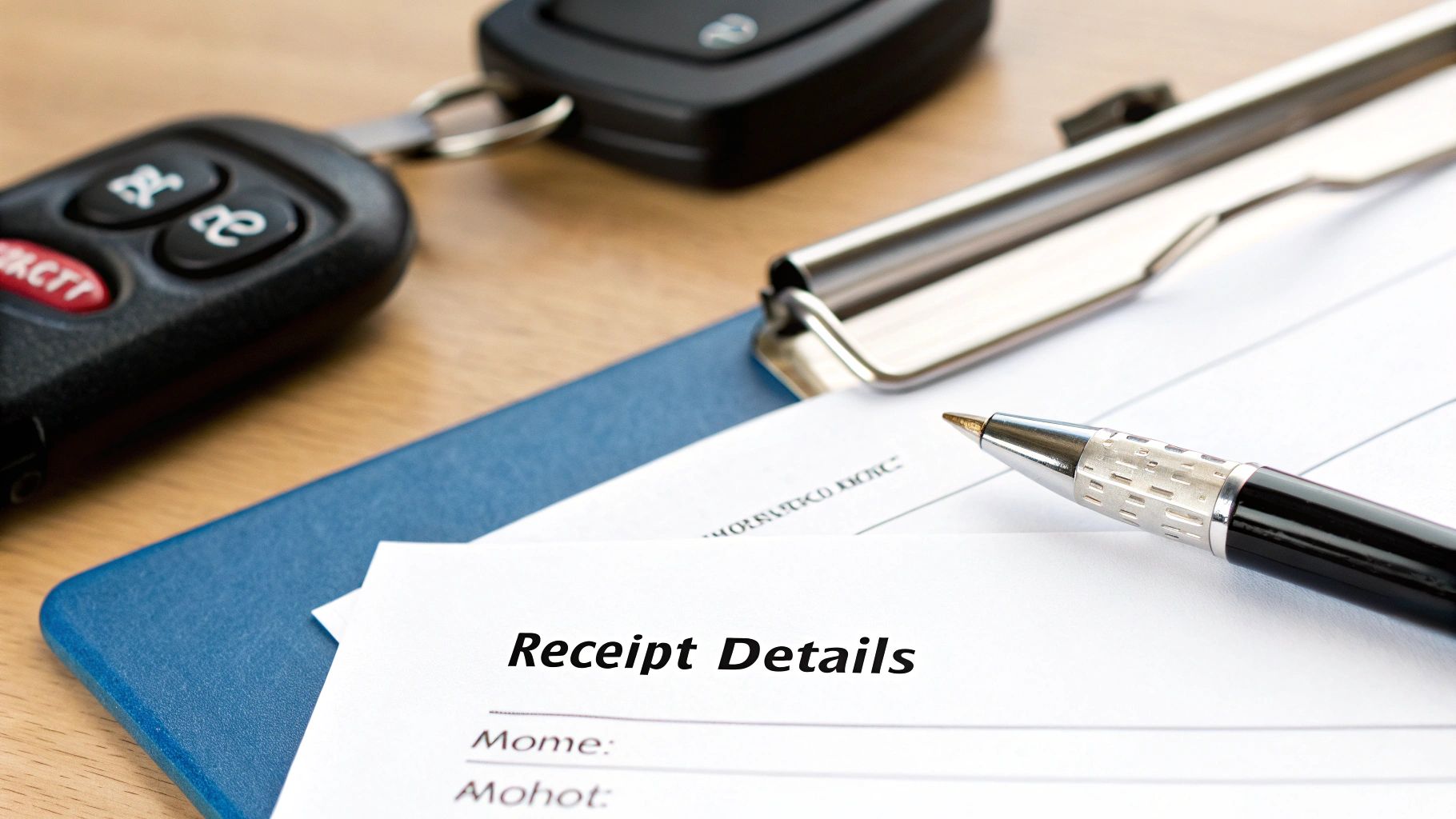
When you're selling a car, a solid receipt is your best friend. It’s not just about jotting down a price on a scrap of paper; it’s about creating a bulletproof record that tells the complete story of the deal. Every single field on that receipt has a job to do, and together, they protect both you and the buyer from headaches down the road.
Think of it like building with LEGOs. If you leave out a few key bricks, the whole thing can fall apart the moment someone questions it. Let's walk through the non-negotiable parts that transform a simple receipt into a document that holds up.
Nail Down the Vehicle's Identity
The absolute first step is to identify the exact car being sold. A vague description like "the blue Honda" is an open invitation for trouble. You need concrete, verifiable details that tie this document to one specific vehicle, no questions asked.
This means you must include:
- Make, Model, and Year: Get specific. Not just "Ford truck," but "2019 Ford F-150."
- Color: It seems basic, but it adds another layer of identification.
- Vehicle Identification Number (VIN): This is the single most important detail on the entire receipt. That 17-character VIN is like the car's social security number—it's completely unique and what the DMV uses to track everything.
A typo in the VIN can invalidate the whole sale. I always tell people to triple-check it: look at the dashboard, the driver-side doorjamb, and the title. They all have to match, period. For a deeper dive into similar documentation in a pro setting, our guide on the essential elements of an auto shop receipt template offers some great parallels.
The Odometer Reading: More Than Just a Number
That mileage reading isn't just a fun fact—it’s a legal declaration. Federal law demands that the seller discloses the vehicle's mileage. It’s a huge factor in the car's value and one of the first things officials look at to spot fraud.
Your receipt needs a dedicated spot for this number. You should also have a simple checkbox or statement confirming if the mileage is the "Actual Mileage" or if there's a known issue, like "Odometer Discrepancy." Getting this wrong can lead to serious legal trouble.
Who's Who: Identifying the Buyer and Seller
A receipt is a two-way street, and it needs to clearly name the people on both sides. If you’re vague here, the document might not be legally binding. You need the full legal names, current addresses, and phone numbers for both the person selling the car and the person buying it.
I've seen it happen: a buyer abandons the car a week later. Without their real information, the seller was on the hook for towing fees. A first name and an old P.O. box just won't cut it.
Following the Money
This is where you eliminate any "he said, she said" arguments about payment. Your receipt needs to be crystal clear about the money changing hands.
- Final Sale Price: Write the price in both numbers (e.g., $15,500) and words ("Fifteen thousand, five hundred dollars"). This simple trick makes it much harder for anyone to alter the document.
- How They Paid: Was it cash? A cashier's check? Bank transfer? Spell it out. This proves the funds were actually received.
- Date of Payment: This is the timestamp that officially seals the deal.
- Deposit (if any): If a deposit was made, note the amount and date it was paid, separate from the final payment.
Even the big players live and die by this kind of documentation. General Motors held its spot as the top U.S. automaker with a 17.3% market share, a figure built from millions of perfectly documented individual sales.
To make this easier, here's a quick-reference checklist of the essential fields your receipt must have.
Essential Fields for Your Car Sale Receipt
| Field Name | Description & Purpose | Example |
|---|---|---|
| Vehicle Details | Uniquely identifies the car being sold. Prevents any confusion or disputes over the subject of the sale. | Make: Ford, Model: F-150, Year: 2019, Color: Blue |
| VIN | The car's unique 17-character ID. The most critical legal identifier, used by the DMV and law enforcement. | 1FTFW1E84KFAXXXXX |
| Odometer Reading | A legally required disclosure of the vehicle's mileage at the time of sale. Notes if the reading is accurate. | 85,240 miles (Actual Mileage) |
| Seller Information | Full legal name, address, and phone number of the person selling the car. | Jane M. Doe, 123 Oak St, Anytown, USA, (555) 123-4567 |
| Buyer Information | Full legal name, address, and phone number of the person buying the car. | John R. Smith, 456 Pine Ave, Othertown, USA, (555) 987-6543 |
| Sale Price | The final agreed-upon price, written in both numbers and words to prevent tampering. | $25,000 (Twenty-five thousand dollars) |
| Payment Details | Specifies how and when the payment was made. Provides proof of the financial transaction. | Paid in full via cashier's check #1234 on 10/26/2023 |
| Signatures & Date | The legal confirmation that both parties agree to the terms. This makes the document a binding agreement. | [Signature of Jane M. Doe], [Signature of John R. Smith], Dated: 10/26/2023 |
Having these fields clearly laid out not only makes the process smoother but ensures your receipt is a strong, defensible document.
The Bottom Line: A well-crafted receipt isn't just paperwork; it's your proof. By getting the vehicle specifics, financial details, and party information right, you create a legal record that gives everyone peace of mind.
Signed, Sealed, Delivered
Last but not least: signatures. A receipt without signatures from both the buyer and seller is just a piece of paper. The act of signing is what turns it into a binding agreement, confirming that both people have read and agreed to everything on it.
Make sure you both sign and date the document at the same time. Then, make two identical copies—one for you, one for the buyer. That way, you both walk away with a legally valid record of the transaction.
Navigating State-Specific Legal Requirements
Finalizing a private car sale isn't a simple, one-size-fits-all deal. That perfect car sale receipt template you drafted might be airtight in one state but completely inadequate just across the border. Every state’s Department of Motor Vehicles (DMV) has its own playbook for how a vehicle's ownership legally changes hands. If you ignore those local rules, you can turn a smooth sale into a bureaucratic nightmare for both you and the buyer.
Think of it this way: the federal government sets the basic rules of the road, like requiring odometer disclosures on the title. But it's the states that decide the local speed limits, where the stop signs go, and what specific paperwork you need. What works in a more laid-back state like Arizona might not fly in a place like California, where the documentation demands are notoriously strict.
Understanding Notary and Bill of Sale Rules
One of the first hurdles you might run into is notarization. Some states, like Louisiana, Montana, and Pennsylvania, demand that a Bill of Sale be notarized to be legally valid for a title transfer. This means you and the buyer have to sign the document right there in front of a Notary Public, who then adds their official seal.
A notary's job is to be an impartial witness. They verify everyone's identity and confirm that you're both signing the agreement willingly. It's a small step, but it adds a serious layer of legal protection and makes the sale much harder to dispute later. If you’re in one of these states, a simple signed receipt just won't cut it when the buyer goes to the DMV.
On the flip side, plenty of states don't require notarization at all. In places like Florida or Texas, as long as the key information is on the receipt and both parties have signed it, the document is legally binding. This is exactly why you have to check your local DMV’s website before you hand over the keys.
Don't ever assume your state's rules are the same as your neighbor's. A quick search for "[Your State] DMV private car sale requirements" is the single most important thing you can do to make sure your transaction is buttoned up and final.
The "As-Is" Clause and Why State Law Matters
For anyone selling a car privately, the "as-is" clause is your best friend. This simple statement makes it clear that the vehicle is sold in its current condition, with absolutely no warranties, either expressed or implied. It's what protects you from getting a call three weeks later about a transmission problem the buyer wants you to pay for.
But here’s the catch: the power of that clause can differ from state to state. While most states fully uphold "as-is" sales between private individuals, some have consumer protection laws that might come into play, though these typically apply to dealerships. The wording you use is crucial. A generic clause is good, but one that aligns with your state’s specific legal language is far better.
Some states even take the guesswork out of it by providing official Bill of Sale forms with all the required legal language built right in. If your state offers one, use it. It’s always the safest bet because you know it was designed to meet every local statute.
This isn't just a niche issue; it's about navigating a massive market. With projections for global light-vehicle sales expected to hit around 91.7 million units in 2025, the sheer volume of transactions highlights why getting the local details right is so critical. You can learn more about these global automotive sales trends to see the bigger picture.
Your Game Plan for Staying Compliant
Before you even think about meeting a buyer, run through this checklist to make sure your car sale receipt is legally sound where you live:
- Go to the Source: Your first and only stop should be your state's official DMV website. Look for pages on "selling a vehicle" or "private party sales."
- Use Official Forms: If your state has an official Bill of Sale form (like California's REG 135), download it and use it. Don't try to reinvent the wheel.
- Check for Notary Requirements: Find out definitively if signatures need to be notarized. If they do, plan on meeting the buyer at a bank or a dedicated notary service to sign the final paperwork.
- Know the Title Transfer Rules: Understand exactly what the buyer will need from you. It’s usually the signed-off title and your compliant Bill of Sale, but there might be other state-specific forms.
Taking a few minutes to confirm these local rules is the best way to protect yourself from future headaches and give your buyer everything they need for a smooth, hassle-free transfer of ownership.
Common Mistakes That Can Invalidate Your Car Sale Receipt
Having a solid car sale receipt template is a great first step, but even the best template is only as good as the information you put in it. It's surprisingly easy to make a small mistake that can cause huge legal and financial headaches down the road, sometimes even invalidating the entire document.
These aren't just minor clerical errors. Think of them as cracks in your legal armor. They can lead to absolute nightmares at the DMV, tax complications, or even ownership disputes. Your completed receipt is the final word on the transaction, so let's walk through the common pitfalls people fall into and how you can avoid them.
The Danger of Being Vague
One of the fastest ways to undermine a receipt is by using vague or incomplete descriptions. When you're trying to finalize a sale, it’s tempting to rush through the paperwork, but ambiguity is your worst enemy here.
Here are a few classic mistakes I see all the time:
- "Paid in full" without a date: This simple phrase is practically meaningless without a specific date attached. It leaves the door wide open for arguments about when the deal was actually finalized, which is a huge deal for determining liability.
- Forgetting the payment method: Just writing down the price isn't enough. Was it cash? A bank transfer? A cashier’s check? Specifying the method creates a clear financial trail if the payment is ever questioned.
- Skipping the "as-is" clause: If you don't explicitly state the vehicle is sold "as-is, where-is, with no warranties," a buyer could come back later and claim you made verbal promises about its condition. Always put it in writing.
A car sale receipt should leave zero room for interpretation. Every single detail—from the exact payment date to the specific payment method—needs to be crystal clear to stand up to any kind of scrutiny. Be specific, be thorough, and never assume anything is "obvious."
Even the biggest names in the auto world rely on flawless documentation. Lamborghini, for instance, reported record sales of 10,747 cars in 2025. You can bet that every single one of those high-stakes transactions was backed by meticulous, error-free paperwork. You can read more about Lamborghini's record-breaking year.
Critical Omissions That Cause Major Headaches
Beyond fuzzy language, simply forgetting to include key information can be just as damaging. These aren't optional details; they're the core components that make the document legally binding and useful.
Here’s a real-world cautionary tale: a seller once accidentally transposed two numbers in the VIN. It was an honest mistake. But the buyer spent weeks battling the DMV, unable to register the car because the VIN on the receipt didn't match the one on the title. The entire sale was stuck in limbo until they managed to track down the seller and get a corrected, re-signed document.
Another huge oversight is missing signatures. A receipt isn't a binding agreement until both the buyer and the seller have signed and dated it. Forgetting the buyer's signature means you have no proof they actually agreed to the terms. Forgetting your own signature will just create a roadblock for them at the DMV. The best practice is to sign two identical copies—one for you, one for them.
Finally, an incorrect odometer reading is more than just a mistake; it can be a serious federal offense. Don't guess or round the number up or down. Write down the exact mileage shown on the dashboard at the moment you hand over the keys. If you know the odometer is broken or inaccurate, you are legally required to disclose that in writing on the receipt. Accuracy here isn't just good practice—it's the law.
3 Common Mistakes to Avoid When Creating Your Car Sale Receipt
Knowing what to include is half the battle; knowing what not to do is just as important. I’ve seen countless private car sales get complicated by simple, avoidable errors on the receipt. A flimsy receipt can create major headaches down the road, from registration issues for the buyer to legal disputes for you.
Here are the three most common pitfalls I see and how you can steer clear of them.
Mistake 1: Vague Vehicle Descriptions
This is probably the biggest mistake sellers make. A receipt that just says "2015 Honda Civic" is practically useless. It’s an open invitation for misunderstandings or, in a worst-case scenario, fraud. If the buyer later claims you sold them a different car, how can you prove otherwise?
Your description needs to be specific enough to identify that exact vehicle and no other.
The Fix: Always, and I mean always, include the Vehicle Identification Number (VIN). It's the car's unique fingerprint. Alongside the VIN, list the year, make, model, and the exact odometer reading at the moment of sale. This leaves zero room for interpretation.
Mistake 2: Forgetting the "As-Is" Clause
When you sell a used car privately, you aren't a dealership offering a warranty. The last thing you want is the buyer calling you three weeks later demanding you pay for a new transmission. Without a clear statement to the contrary, you could find yourself in a tricky spot.
An "as-is, where-is" clause is your legal shield. It clearly states that the buyer accepts the vehicle in its current condition, with all its faults, and that you are not responsible for any issues that pop up after the keys change hands.
The Fix: Add a simple but direct statement to your receipt. Something like, "This vehicle is sold as-is, with no warranties, expressed or implied." It's a short sentence that provides a massive amount of protection.
Mistake 3: Missing or Incomplete Signatures
A receipt isn't just a record of payment; it's a legal document that confirms an agreement. An unsigned receipt is just a piece of paper with some numbers on it. It doesn't prove that both parties saw, understood, and agreed to the terms of the sale.
This little oversight can turn a simple transaction into a "he-said, she-said" nightmare if any disputes arise.
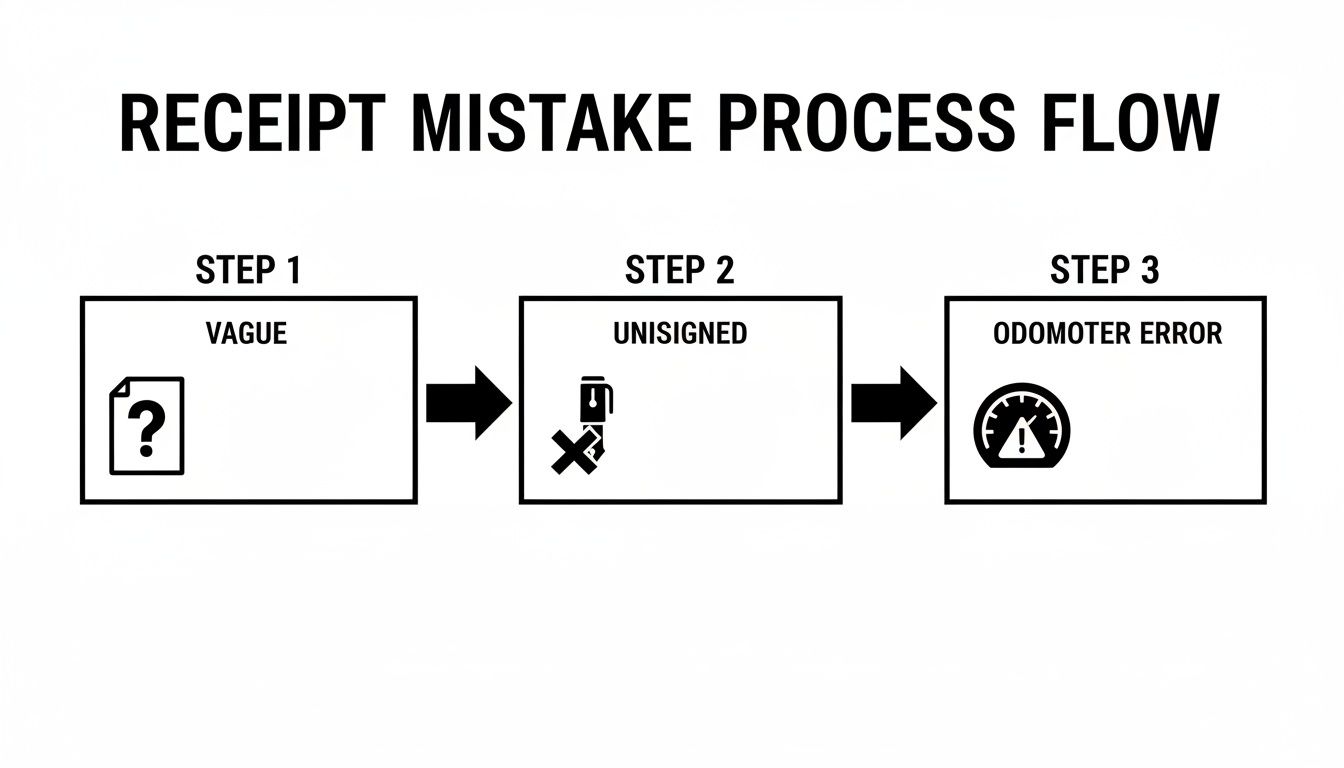
The Fix: At the bottom of the receipt, make sure there are dedicated lines for both the buyer's and seller's signatures, printed names, and the date. Don't just hand over the keys and cash—sit down together and have both parties sign two copies of the completed receipt, one for each of you to keep.
By sidestepping these common errors, you're not just creating a piece of paper; you're finalizing the sale with confidence and clarity, protecting both yourself and the buyer. For some great starting points, you can explore a wide range of professional receipt templates that can be easily adapted for a car sale.
Your Top Car Sale Receipt Questions, Answered
Even after you've built what seems like a perfect receipt, a few nagging questions can pop up. I've been there. Getting these final details right is what separates a decent receipt from an ironclad one that protects everyone involved.
Think of this as the final check-in before you sign on the dotted line. Let's tackle the most common questions I hear so you can walk away from the sale without a single doubt.
Is a Handwritten Receipt for a Car Sale Legally Binding?
Yes, a handwritten receipt can absolutely hold up legally. The real test isn't about fancy printing versus pen and ink; it’s about whether the document has all the crucial pieces of a valid sales contract.
For a handwritten receipt to be worth the paper it's written on, it must have:
- The full legal names and signatures of both you and the buyer.
- The exact date the sale took place.
- A clear description of the car—VIN, make, model, and year are non-negotiable.
- The final sale price and how the payment was made.
- The odometer reading at the moment of sale.
That said, while it can be legal, a typed or professionally generated receipt is always smarter. It completely sidesteps problems like illegible handwriting, which can lead to major headaches and disputes down the road. And remember, always double-check your state's requirements—if they demand a specific Bill of Sale form or notarization, that rule trumps everything else.
What Is the Difference Between a Car Sale Receipt and a Bill of Sale?
People often throw these terms around interchangeably, but they serve two distinct functions. A receipt is your proof of payment—it's evidence that money was exchanged for the car. A Bill of Sale, on the other hand, is the legal instrument that formally transfers the vehicle's ownership from the seller to the buyer.
Here's the thing: your local DMV will almost certainly require a formal Bill of Sale to handle the title transfer. The good news? A well-crafted car sale receipt can easily do both jobs. If your receipt contains all the necessary details and includes a clear statement of ownership transfer (something like, "I, [Seller's Name], hereby sell and transfer ownership of the vehicle described above to [Buyer's Name]"), it effectively serves as both.
My advice? Create one comprehensive document that covers all your bases. Labeling it "Bill of Sale and Receipt of Purchase" is a simple, effective way to make sure it satisfies every legal requirement.
Should I Include an 'As-Is' Clause on the Receipt?
Without a doubt, yes. For a private seller, the "as-is" clause is your single most important piece of protection. This simple phrase makes it crystal clear that the buyer is taking the car in its current state, warts and all.
This little sentence is what stops a buyer from calling you a month later demanding you pay for a surprise repair. It formally states that you haven't made any promises or warranties, spoken or implied, about the car's condition or future reliability.
You don't need a paragraph of legal jargon. A straightforward line like, "This vehicle is sold as-is, where-is, with no warranties expressed or implied," is all it takes to give you a powerful layer of legal protection.
Who Needs to Keep a Copy of the Car Sale Receipt?
This is non-negotiable: both the buyer and the seller must walk away with a signed, identical copy of the receipt. It's equally critical for both of you.
The buyer needs their copy as the ultimate proof of purchase. It's the document they'll hand over at the DMV to get the car registered and the title officially put in their name.
The seller needs their copy to prove they no longer own the car. This piece of paper is your defense against any liability after the keys change hands—from parking tickets to accidents. Make two copies, and have both signed at the very same time.
Ready to create a professional, error-free receipt in minutes? Receipt Maker offers customizable templates perfect for any car sale. Skip the hassle and generate a legally sound document with all the essential fields built right in. Create your free car sale receipt now.