8 Essential Small Business Bookkeeping Tips for Success in 2026
Discover 8 actionable small business bookkeeping tips to streamline your finances, save time, and stay tax-ready. Master your books and boost your bottom line!
For any small business owner, mastering your finances is not just about counting money. It's about understanding the financial health of your venture to make smarter decisions, fuel growth, and achieve long-term stability. Effective bookkeeping is the bedrock of this financial clarity. Yet, for many entrepreneurs, it often becomes a source of stress, filled with disorganized receipts, confusing spreadsheets, and the looming dread of tax season.
This guide cuts through the complexity. We've compiled a list of actionable, practical small business bookkeeping tips designed to transform your financial management from a tedious chore into a powerful strategic advantage. You will learn specific methods for organizing records, reconciling accounts, and proactively managing your cash flow. We will cover everything from choosing the right accounting method to implementing systems that ensure tax-readiness all year long.
Instead of generic advice, this article provides a clear roadmap. By implementing these concrete habits and workflows, you'll not only save significant time and reduce costly errors but also gain the confidence that comes with having a crystal-clear view of your business's performance. Consider this your essential toolkit for building a stronger, more resilient business founded on solid financial practices.
1. Implement Organized Receipt Management Systems
Effective bookkeeping begins with a foundational, yet often overlooked, practice: systematic receipt management. This involves establishing a centralized system for capturing, organizing, and storing every business receipt, whether physical or digital. A disciplined approach ensures that every transaction is documented, easily retrievable for bookkeeping entries, and readily available to support tax deductions or withstand an audit. Moving from a shoebox of crumpled papers to a digital system is one of the most impactful small business bookkeeping tips you can implement.
Why This Is a Foundational Practice
A robust receipt management system is your business's financial memory. It provides the necessary proof of purchase for every expense you claim, protecting you from costly disputes with tax authorities. It also simplifies the process of tracking spending, managing budgets, and reimbursing employees. For businesses that need to create receipts for customers, using a tool like Receipt Maker ensures all outgoing documentation is standardized, professional, and easily logged. For those interested in creating professional documentation, you can explore various options with a free online receipt template.
Actionable Tips for Implementation
To build an effective system, start by digitizing everything immediately. Use a scanner or a dedicated mobile app to capture paper receipts as soon as you receive them.
- Create a Naming Convention: Save digital files with a consistent format for easy searching and sorting. A great structure is YYYY-MM-DD_Vendor_Amount (e.g.,
2023-10-26_OfficeSuppliesCo_112.50.pdf). - Establish a Folder Structure: Organize your digital receipts in cloud storage (like Google Drive or Dropbox) with a logical hierarchy. Create primary folders for each year, then subfolders for months or expense categories (e.g.,
2023 > 10-October > Office Supplies). - Schedule Regular Reviews: Dedicate a specific time each week or month to process, categorize, and file any new receipts. This prevents backlogs and ensures your records are always up-to-date.
- Know Your Retention Policy: The IRS generally requires you to keep records for three to seven years. Ensure your digital storage plan and backup protocols align with these legal requirements.
2. Separate Personal and Business Finances
One of the most critical small business bookkeeping tips is to draw a clear line between your personal and business finances. This means opening and maintaining a dedicated business bank account and credit card, used exclusively for all business-related income and expenses. Commingling funds might seem convenient at first, but it quickly creates a tangled financial web that is difficult to unravel, leading to inaccurate records, missed tax deductions, and significant legal risks.

Why This Is a Foundational Practice
Separating your finances is the bedrock of accurate bookkeeping and legal protection. It simplifies tracking your business's true profitability and cash flow, making it easier to see what money is coming in and where it is going. For tax purposes, it creates a clean, auditable trail of business-only transactions, substantiating every deduction you claim. Crucially, for incorporated businesses like LLCs or corporations, this separation upholds the "corporate veil," protecting your personal assets from business debts and lawsuits. Without this distinction, your personal car, home, and savings could be at risk.
Actionable Tips for Implementation
Discipline is key to maintaining this financial separation. The goal is to ensure every dollar is accounted for in its proper place, preventing confusion and streamlining your bookkeeping process.
- Open Accounts Immediately: Before you make your first sale or purchase, open a business checking account and credit card. Start with a clean slate from day one.
- Establish a Payment Rule: Make it a strict policy that all business income is deposited into the business account and all business expenses are paid from it.
- Set Up Owner's Draws: Instead of using the business account for personal expenses, pay yourself a salary or an "owner's draw" by transferring a set amount from your business account to your personal account.
- Conduct Monthly Reviews: At the end of each month, review both your business and personal account statements. If you find a business expense on a personal card, reimburse yourself from the business account immediately and document it properly.
3. Choose the Right Accounting Method (Cash vs. Accrual)
One of the most critical decisions in your bookkeeping setup is selecting an accounting method. This choice dictates the timing of when you recognize revenue and expenses, fundamentally shaping your financial statements and tax obligations. The two primary methods are cash basis and accrual basis, and understanding the difference is a cornerstone of effective financial management. Making a conscious choice here, rather than defaulting, is one of the most strategic small business bookkeeping tips you can apply.
Why This Is a Foundational Practice
Your accounting method directly impacts the accuracy of your financial picture. Cash basis accounting is simpler: you record income when you receive cash and expenses when you pay them. Accrual basis accounting is more complex but often provides a more accurate view of performance by recording income when it's earned and expenses when they are incurred, regardless of when money changes hands. This choice affects everything from tax planning to your ability to secure loans, as it determines how profitable your business appears on paper during a specific period.
Actionable Tips for Implementation
Most small businesses with annual gross receipts under $25 million (as per IRS guidelines) can choose either method, but the decision should be informed and consistent.
- Consult a Professional: Discuss your business model with an accountant or tax professional. A service-based business with long payment cycles may benefit from accrual, while a small retail shop might thrive on the simplicity of cash basis.
- Understand the Implications: Cash basis is straightforward and provides a clear view of cash flow. Accrual basis is better for matching revenues with the expenses that generated them, offering a more accurate long-term profitability picture, which is crucial for businesses with inventory.
- Maintain Consistency: Once you choose a method, you must use it consistently from year to year. Changing methods requires formal approval from the IRS.
- Document Everything Correctly: Regardless of your choice, meticulous record-keeping is key. For accrual accounting, it is essential to track accounts receivable (money owed to you) and accounts payable (money you owe) diligently.
4. Reconcile Accounts Regularly and Methodically
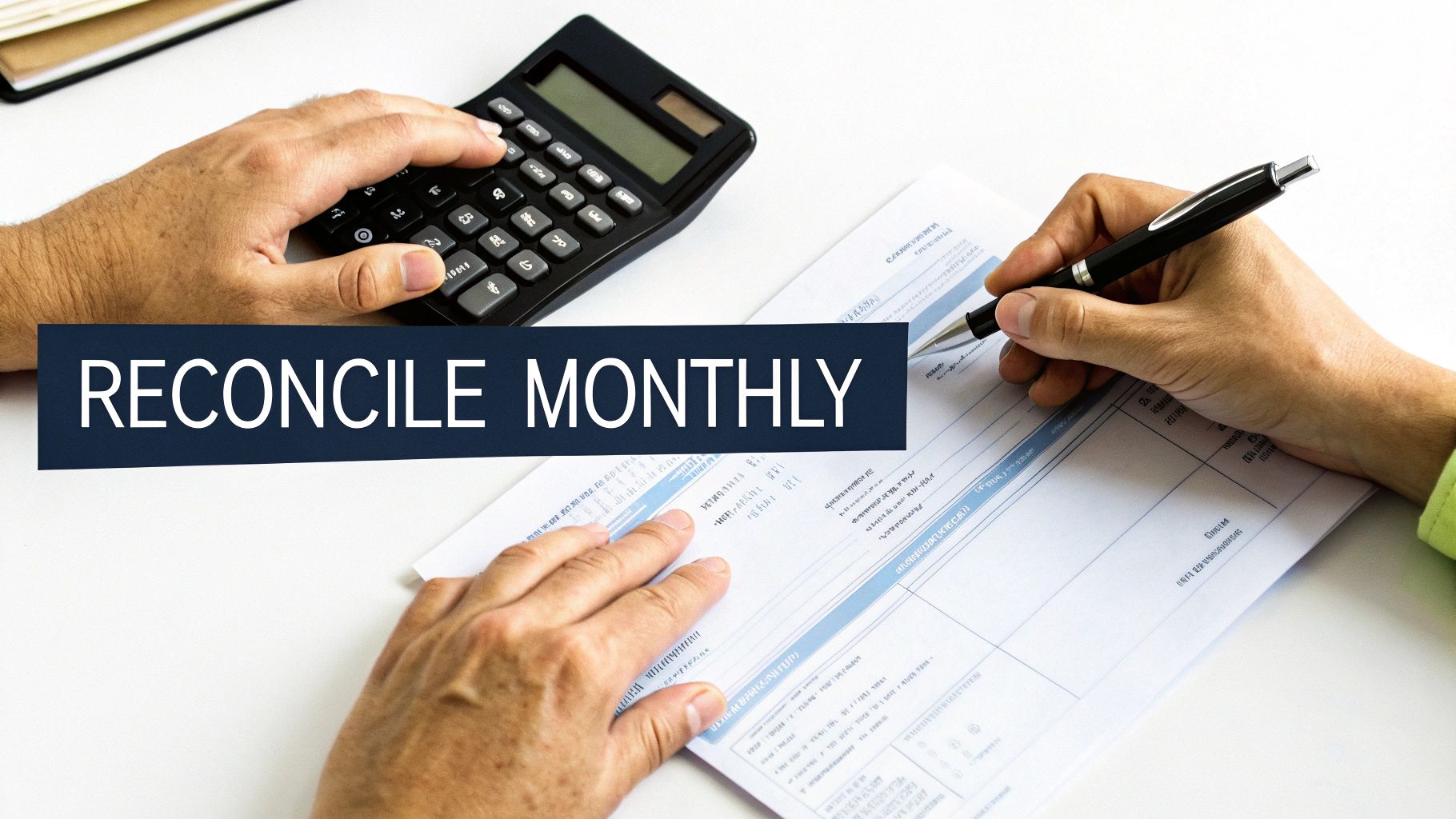
Account reconciliation is the process of comparing your internal financial records against external statements from banks, credit card companies, and other financial institutions. This methodical check ensures that the money leaving an account matches the money spent, and the money entering an account matches the money received. Regularly performing this task is one of the most critical small business bookkeeping tips for maintaining financial accuracy, detecting fraud, and gaining a clear picture of your cash flow.
Why This Is a Foundational Practice
Consistent reconciliation acts as a crucial internal control for your business. It catches discrepancies early, such as bank errors, unauthorized transactions, or missed payments, before they snowball into larger financial problems. For cash-heavy businesses like retail stores or restaurants, it verifies that daily deposits match point-of-sale records. This practice provides confidence that your financial statements are reliable, which is essential for making informed business decisions, securing loans, and simplifying year-end tax preparation.
Actionable Tips for Implementation
To integrate this habit, set a recurring monthly appointment on your calendar specifically for reconciliation. Treat it as a non-negotiable financial health check-up.
- Create a Checklist: Develop a standard reconciliation checklist covering all accounts. Include steps like verifying deposits, checking off cleared checks and debits, noting bank fees, and confirming interest earned.
- Go Line-by-Line: Download your bank and credit card statements at the end of each month. Match every single transaction against the entries in your accounting software or ledger.
- Investigate Discrepancies Immediately: If an amount doesn't match or a transaction is unfamiliar, flag it and investigate right away. Waiting makes it harder to recall details or dispute fraudulent charges.
- Leverage Technology: Most modern accounting software includes reconciliation tools that can automatically import bank data and flag potential mismatches, significantly speeding up the process.
- Maintain a Log: Keep a record of when each account was reconciled and who performed the review. This creates a clear audit trail and reinforces accountability.
5. Categorize Expenses Consistently and Accurately
Properly categorizing your expenses is the difference between having a simple list of transactions and having actionable financial intelligence. This practice involves assigning every business expense to a specific, logical group within your chart of accounts, such as office supplies, marketing, or utilities. Accurate and consistent categorization is a cornerstone of reliable financial reporting, making tax preparation smoother and revealing crucial insights into your company's spending habits.
Why This Is a Foundational Practice
Consistent expense categorization transforms raw data into a clear story about your business's financial health. It allows you to generate accurate reports like the Profit & Loss statement, which is essential for understanding profitability and making strategic decisions. For instance, a retail store can track its cost of goods sold separately from marketing expenses to analyze profit margins, while a freelance designer can monitor software subscription costs to manage overhead. This level of detail is critical for identifying potential cost savings and ensuring you claim every eligible tax deduction.
Actionable Tips for Implementation
To build a reliable categorization system, start with a standard chart of accounts and customize it for your industry. A well-organized system ensures that every dollar is accounted for correctly, every time.
- Develop a Categorization Guide: Create a simple document that defines each expense category and provides examples. This ensures anyone handling bookkeeping, from you to an employee, applies the rules consistently.
- Categorize at the Source: Whenever possible, assign a category to an expense the moment it occurs. When you capture a receipt with a mobile app or create one for a customer, immediately tag it with the correct category (e.g., "Materials," "Travel").
- Start Simple, Expand as Needed: Begin with broad categories like "Marketing," "Utilities," and "Office Supplies." You can create more granular subcategories later if necessary (e.g., splitting "Marketing" into "Digital Ads" and "Print Media").
- Use Software Rules: Leverage accounting software to create rules that automatically categorize recurring transactions from specific vendors, saving time and reducing errors.
- Schedule Monthly Reviews: Dedicate time each month to review your categorized expenses. This helps you spot misclassifications, identify spending trends, and ensure your financial statements are accurate. You can even design custom receipt templates for business that include a field for easy categorization.
6. Track and Manage Cash Flow Proactively
Profitability on paper does not guarantee survival; running out of cash does. Proactive cash flow management is the practice of continuously monitoring, analyzing, and optimizing the movement of money into and out of your business. It involves understanding the timing mismatches between when revenue is earned and when cash is received, as well as when expenses are incurred versus when they are paid. For any small business, mastering this is one of the most critical bookkeeping tips for ensuring long-term stability and growth.

Why This Is a Foundational Practice
Effective cash flow management is the lifeblood of your business. It provides the visibility needed to make informed operational decisions, like when to hire, invest in new equipment, or expand marketing efforts. Without it, even a profitable company can face a liquidity crisis, unable to pay suppliers, meet payroll, or cover rent. For instance, a service contractor may complete a large project in January but not receive payment until March, creating a dangerous cash gap that must be managed to cover ongoing expenses.
Actionable Tips for Implementation
To gain control over your cash flow, shift from a reactive to a proactive mindset. Start by creating a simple cash flow projection to forecast your financial position over the next several weeks.
- Create a 13-Week Cash Flow Forecast: Build a simple spreadsheet listing all anticipated weekly cash inflows (customer payments, loans) and outflows (payroll, rent, supplier bills). This provides a short-term operational view.
- Aggressively Manage Receivables: Follow up on overdue invoices immediately. This is often the fastest way to improve your cash position. Consider offering small discounts for early payments to accelerate inflows.
- Strategically Time Payables: If possible, negotiate longer payment terms (like Net 30 or Net 60) with your suppliers. Pay your bills on time, but not necessarily early, to hold onto your cash longer.
- Maintain a Cash Reserve: Build and protect a cash buffer equivalent to at least one to three months of essential operating expenses. This reserve acts as a crucial safety net for unexpected downturns or opportunities.
7. Maintain Detailed Records and Documentation
Beyond simply managing receipts, effective bookkeeping requires maintaining comprehensive and organized records for every financial activity your business undertakes. This involves keeping detailed documentation of all transactions, supporting papers, and key financial decisions. Diligent record-keeping is not just a best practice; it is a legal requirement that protects your business from risk, simplifies tax filing, and provides the data needed for informed strategic planning. Think of it as creating a complete financial history that tells the story of your business's operations.
Why This Is a Foundational Practice
Detailed documentation is your primary defense in an audit and the foundation for accurate financial reporting. It proves the validity of every income and expense entry in your books. For example, a cafe needs to organize receipts by transaction date with daily reconciliation notes to track performance, while a pharmacy must maintain meticulous records of prescriptions and insurance reimbursements for compliance and profitability analysis. Without this level of detail, you cannot accurately assess financial health, secure loans, or make confident growth decisions. It ensures every number on your financial statements is verifiable and trustworthy.
Actionable Tips for Implementation
Start by establishing a standardized system for all business documentation, not just receipts. Consistency is key to making this one of the most effective small business bookkeeping tips you can adopt.
- Establish a Digital Filing System: Immediately create a logical folder structure in cloud storage. Organize files by date, vendor, or category (e.g.,
2024 > Invoices > VendorName). This keeps everything searchable and secure. - Use a Consistent Naming Convention: Name your digital files systematically to find them easily. A good format is YYYY-MM-DD_DocumentType_Vendor_Amount.pdf (e.g.,
2024-11-15_Invoice_CreativeSolutions_450.00.pdf). - Document Business Purpose: For any expense that isn't self-explanatory, especially those over $75, make a note directly on the digital or physical receipt detailing its business purpose.
- Generate Professional Outgoing Documents: Ensure all documents you provide to clients, like invoices and receipts, are complete and professional. Using a dedicated tool can help standardize this process; you can learn more about how to create a receipt online that includes all necessary details.
- Adhere to Retention Policies: The IRS typically requires you to keep records for at least three to seven years. Create a formal record retention policy and ensure your digital backup and archiving plan complies with these rules.
8. Use Accounting Software or Hire Professional Support
Attempting to manage your finances with manual spreadsheets is a recipe for errors, lost time, and missed opportunities. Leveraging technology or professional expertise is a pivotal step in maturing your financial operations. This involves either adopting modern accounting software to automate tasks or hiring a bookkeeper or accountant to provide expert oversight, ensuring accuracy, compliance, and strategic financial management.
Why This Is a Foundational Practice
Investing in the right tools or people transforms bookkeeping from a reactive chore into a proactive business function. Accounting software automates tedious processes like bank reconciliation, expense categorization, and financial reporting, providing real-time visibility into your business's health. Professional support offers specialized knowledge on tax strategy, financial planning, and compliance that software alone cannot provide. This investment pays for itself through reduced errors, maximized tax deductions, and more time to focus on core business activities.
Actionable Tips for Implementation
The right choice depends on your business's complexity, transaction volume, and budget. For many, a hybrid approach works best.
- Start with Scalable Software: Begin with free or low-cost options like Wave or ZipBooks. As your business grows, you can graduate to more robust platforms like QuickBooks Online or Xero that offer deeper integrations and features.
- Integrate Your Tools: Choose software that integrates with other business systems. For example, connecting a tool like Receipt Maker with your accounting software can create a seamless workflow from receipt creation to expense logging.
- Define Professional Roles: If hiring help, decide what you need. A bookkeeper can handle daily transaction management and reconciliation, while an accountant is better suited for high-level tax planning and financial strategy. Consider a part-time bookkeeper for monthly tasks and a CPA for annual reviews.
- Compare the Cost-Benefit: Analyze the cost of a software subscription versus the hourly rate of a professional. Often, the time saved and errors avoided by using either or both provide a significant return on investment, making this one of the most effective small business bookkeeping tips.
8-Point Small Business Bookkeeping Comparison
| Item | Implementation Complexity 🔄 | Resource & Cost ⚡ | Expected Outcomes 📊 | Ideal Use Cases 💡 | Key Advantages ⭐ |
|---|---|---|---|---|---|
| Implement Organized Receipt Management Systems | Moderate — initial setup and staff discipline | Low–Medium — software/subscription and training time | Easier retrieval, audit trail, fewer lost receipts | Small businesses, freelancers, multi-location retailers | Centralized records; faster reporting; audit readiness |
| Separate Personal and Business Finances | Low — open and maintain separate accounts; needs discipline | Low — account fees and maintenance | Clearer books, simplified taxes, liability protection | Sole proprietors, LLCs, growing freelancers | Simplifies reconciliation; protects personal assets |
| Choose the Right Accounting Method (Cash vs. Accrual) | Moderate — requires analysis and consistent application | Low–Medium — potential accountant consultation | Proper revenue/expense timing; tax alignment | Small cash businesses (cash) vs. inventory/invoicing firms (accrual) | Accurate financial reporting; compliance with tax rules |
| Reconcile Accounts Regularly and Methodically | Moderate — recurring monthly process | Medium — staff time or software/bookkeeper | Early error/fraud detection; accurate balances | Cash-heavy businesses, retail, restaurants | Prevents surprises; simplifies year-end close |
| Categorize Expenses Consistently and Accurately | Moderate — design chart of accounts and train staff | Low–Medium — setup time and possible software rules | Accurate P&L, clearer spending patterns | Any business needing reliable financial analysis | Better reporting; easier tax substantiation |
| Track and Manage Cash Flow Proactively | High — ongoing forecasting and follow-up | Medium–High — forecasting tools and collections effort | Improved liquidity, fewer shortfalls, informed decisions | Seasonal businesses, project-based firms, subscriptions | Prevents cash crises; informs financing and timing decisions |
| Maintain Detailed Records and Documentation | Moderate–High — continuous filing and backups | Medium — storage, backup, and staff time | Audit readiness; substantiation for deductions; reliable data | Businesses facing audits or regulatory requirements | Reduces audit risk; quick retrieval for disputes or filings |
| Use Accounting Software or Hire Professional Support | Variable — software setup or onboarding professionals | Medium–High — subscriptions or professional fees | Automation, real-time reporting, reduced errors | Growing businesses or high transaction volume firms | Saves time; improves accuracy; provides expert oversight |
From Bookkeeping Burden to Business Superpower
Navigating the financial landscape of a small business can often feel like a complex and relentless task. However, the journey from financial confusion to crystal-clear clarity is paved with consistent habits and smart systems. The small business bookkeeping tips we've explored are not just individual tasks on a checklist; they are interconnected components of a powerful financial engine that drives your company forward.
By committing to simple yet profound practices like separating your personal and business finances, you create a foundational boundary that simplifies every subsequent step. This, combined with a methodical approach to reconciling your accounts and consistently categorizing every expense, transforms raw data into a reliable narrative of your business's health. You move from simply recording history to actively shaping your future.
Key Takeaways for Financial Mastery
The core message woven through each of these strategies is proactive management. Don't wait for tax season to become an archaeologist, digging through a year's worth of transactions. Instead, adopt a forward-looking mindset.
- Consistency Over Intensity: A small, consistent daily or weekly effort is far more effective than a frantic, once-a-year scramble. Spending just 15 minutes each week reconciling accounts or organizing receipts prevents small issues from snowballing into significant problems.
- Data as a Strategic Asset: Your books are more than just a legal requirement; they are a strategic goldmine. Accurate cash flow tracking allows you to anticipate shortfalls, while proper expense categorization reveals where your money is truly going, highlighting opportunities for cost savings and smarter investments.
- Leverage Technology and Expertise: You don't have to manage everything alone. Modern accounting software automates tedious tasks, reducing human error and freeing up your valuable time. Likewise, knowing when to call in a professional bookkeeper or accountant is a sign of a savvy business owner, not a weakness.
Your Action Plan for Bookkeeping Success
Mastering your finances is an ongoing process, not a one-time fix. The path to transforming your bookkeeping from a burden into a superpower begins with small, deliberate steps. Start today by choosing one or two tips from this guide to implement immediately. Perhaps it's finally opening that dedicated business bank account or scheduling a recurring weekly appointment on your calendar for financial review.
Once that new habit is established, build on it by adding another. This incremental approach makes the process manageable and sustainable. The clarity and control you gain will be transformative, empowering you to make confident, data-driven decisions that steer your business toward long-term profitability and success. Stop letting your finances manage you; it's time to make your books work for you.
Ready to tackle one of the most crucial small business bookkeeping tips? Streamline your record-keeping and create professional, organized expense documentation with Receipt Maker. Our tool makes it easy to generate custom receipts for every transaction, ensuring your records are always complete and compliant. Visit Receipt Maker to simplify your receipt management today.